Digital transformation in cement manufacturing is the process of connecting kiln operations, raw material chemistry, grinding efficiency, maintenance scheduling, and supply chain logistics into a unified data platform that turns isolated process signals into coordinated operational intelligence.
For cement plant CTOs, this isn’t about adding sensors to existing equipment. It’s about building a data architecture where kiln thermal efficiency, clinker ratio targets, grinding energy consumption, and dispatch logistics all feed into the same decision layer. When a shift in raw material chemistry changes the optimal burning zone temperature, the system should adjust fuel mix recommendations, predict the impact on clinker quality, and update the financial forecast without anyone opening a spreadsheet.
Most cement plants today have the sensors. What they lack is the connected intelligence layer that turns process data into operational and financial decisions.
The operational reality: where cement plants lose margin
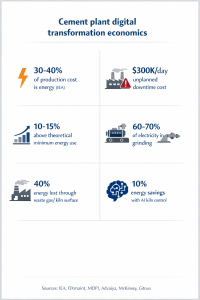
Energy dominates cement economics more than any other manufacturing sector. IEA data shows energy accounts for 30% to 40% of total production costs (IEA / Imubit, 2025). Academic research further specifies that 70% of variable costs go to energy, split between kiln thermal energy at 33% and electrical energy at 37% (Electrical Engineering / Springer, 2021). Fuel alone consumes the kiln, which uses over 90% of a plant’s total fuel (OXmaint, 2025).
A single day of unplanned downtime costs cement manufacturers up to $300,000 (Birlasoft / OXmaint, 2025). Maintenance adds another 15% to 25% of operating spend (The Cement Institute / Imubit, 2025). Together, energy and maintenance can determine whether a campaign finishes profitably.
Where the process efficiency gap sits
Most cement plants operate 10% to 15% above their theoretical minimum energy consumption (OXmaint, 2025). Specific heat consumption in typical plants ranges from 3,000 to 3,500 MJ per ton of clinker, while best-in-class operations achieve around 3,300 MJ per ton (Advaiya / Imubit, 2025). About 40% of total input energy is lost through waste gas and heat dissipation on the kiln surface (MDPI / Clean Technologies, 2025).
Finish grinding consumes 60% to 70% of a plant’s total electricity (Advaiya, 2025). Yet most plants still rely on manual operator adjustments to separator speed, feed rate, and mill pressure. Each sub-optimal adjustment compounds across thousands of operating hours.
54% of I&O leaders cite cost optimization as their top AI goal (Gartner, October 2025). In cement, the data foundation typically isn’t ready. Most plants have data locked in isolated historians, manual logs, or aging distributed control systems that don’t communicate with each other.
The market is responding
The digital transformation market in cement is projected to reach $2.5 billion by 2025, driven by cloud adoption at 45% CAGR (Gitnux, 2026). 87% of producers are prioritizing digital initiatives (iFactory AI, 2025). AI kiln control has yielded 10% energy savings with ROI in 18 months at multiple sites (Gitnux / CEMEX, 2024).
McKinsey measured up to 10% throughput and energy efficiency improvement from AI in autonomous mode at a North American cement plant (McKinsey / Advaiya, 2025). Titan America’s Pennsuco facility achieved 6% electrical energy reduction while doubling alternative fuel usage (Advaiya, 2025).
Where the industry is heading
AI-driven kiln optimization and closed-loop control
The progression from monitoring to optimization follows a clear maturity path. Stage one connects and collects data from IoT sensors on kilns, preheaters, coolers, and mills. Stage two predicts and visualizes, with dashboards flagging efficiency drift and models forecasting free lime excursions. Stage three implements closed-loop AI control, with active adjustment of fuel feed, kiln speed, air flow, and separator speed continuously without operator input (Advaiya / Gartner, 2025).
Most cement plants today are at stage one or two. The competitive advantage belongs to operators moving to stage three.
Clinker ratio reduction through real-time SCM management
Substituting supplementary cementitious materials like GGBS, fly ash, or calcined clay reduces energy and emissions per ton. But variable SCM quality demands real-time process adjustments that manual control can’t deliver consistently. AI models trained on raw material composition, blending ratios, and grinding parameters maintain quality targets while maximizing clinker substitution.
Predictive maintenance moving from calendar to condition
AI algorithms now predict kiln failures with 92% accuracy in plants with connected sensor networks (Gitnux, 2024). Predictive analytics has reduced maintenance costs by 27% in European cement plants (Gitnux, 2024). The shift from preventive maintenance schedules to condition-based interventions eliminates both over-maintenance and surprise failures.
Digital twins for process simulation
68% of global cement producers have adopted digital twins for plant optimization, improving simulation accuracy by 25% (Gitnux, 2023). Holcim launched the world’s first digital twin cement plant, integrating enterprise software with performance prediction algorithms and 3D modeling (ZKG International / Holcim, 2023).
How Azure AI, Databricks, and Power BI fit the cement stack
Azure IoT and AI: the intelligence layer
Azure IoT Hub ingests telemetry from kiln thermocouples, preheater pressure sensors, cooler grate speed monitors, mill power meters, and raw material analyzers across every production line. Azure Machine Learning trains models on this process data to optimize burning zone temperature, predict free lime content, and recommend fuel mix adjustments for alternative fuel substitution.
Azure Digital Twins creates virtual replicas of kiln systems, enabling plant managers to simulate the impact of raw material changes, maintenance interventions, or production rate adjustments before implementing them on the live process.
Databricks: unified process and supply chain analytics
Databricks provides the lakehouse architecture where process historian data, raw material chemistry, quality lab results, maintenance records, and dispatch logistics converge. Databricks was named a Leader in both the 2025 Gartner Magic Quadrant for Data Science and Machine Learning Platforms and the 2025 Gartner Magic Quadrant for Cloud Database Management Systems (Gartner / Databricks, 2025).
For cement plants, Databricks processes high-frequency sensor data alongside batch quality test results and supply chain information in a single analytical environment. Predictive models that forecast cement strength by day seven with high accuracy require exactly this kind of multi-source data integration.
Power BI: operational dashboards from kiln to dispatch
Power BI embeds real-time dashboards directly inside the operational workflow. Kiln operators see burning zone temperature trends alongside fuel consumption and free lime predictions. Plant managers see specific heat consumption, clinker factor, and grinding efficiency across all production lines. Dispatch teams see inventory levels, truck scheduling, and delivery compliance on the same platform.
Energy optimization directly reduces Scope 1 (kiln fuel) and Scope 2 (electrical) emissions. Power BI dashboards feed ESG workflows for BRSR, CSRD, or GHG Protocol compliance reporting.
How Advaiya helps cement companies modernize operations
Advaiya works with organizations across manufacturing, cement, and infrastructure on data infrastructure and embedded analytics implementations within the Microsoft ecosystem. Advaiya has published detailed guidance on AI-driven kiln optimization for cement manufacturers, outlining the four-stage maturity path from data collection through closed-loop AI control.
When Advaiya built an ESG analytics board for a diversified conglomerate including manufacturing operations, the data architecture challenges mirrored what cement plants face: fragmented data sources across production sites, complex compliance requirements, and the need for operational dashboards that drive real-time decisions. The results demonstrated what unified analytics delivers: 20+ KPIs tracked, 300+ data validation workflows, 90%+ reduction in manual data handling, and a 95% data quality index (Advaiya Case Study Compendium).
Advaiya brings the enterprise data architecture expertise that connects Azure IoT, Databricks, and Power BI to the specific way cement operations manage kiln optimization, clinker quality, grinding efficiency, and dispatch logistics.
Connect with Advaiya about cement plant digital transformation →
FAQs