Strategic portfolio management in life sciences is the discipline of evaluating, prioritizing, and optimizing development programs, product investments, and regulatory initiatives against an organization’s strategic objectives.
It goes beyond traditional project portfolio management. SPM connects individual program decisions, which compounds advance, which get shelved, and where resources flow to the organization’s long-term risk tolerance, financial goals, and therapeutic strategy.
For CTOs and R&D leadership across pharmaceuticals, biotechnology, and medical devices, SPM is where three forces converge: the economics of development, the complexity of regulatory compliance, and the constraints of finite scientific talent. Getting anyone wrong at the portfolio level cascades into years of lost time and capital.
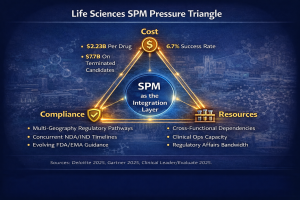
The three-way pressure: cost, compliance, and resource constraints
The cost pressure keeps intensifying. Deloitte’s 15th annual innovation report found that the average cost to develop a drug reached $2.23 billion in 2024, with development time from Phase I through filing now exceeding 100 months (Deloitte, March 2025).
Phase I-to-approval success rates fell to 6.7%, down from 10% a decade ago (Clinical Leader / Evaluate, 2025). The top 20 companies spent $7.7 billion on terminated candidates in a single year (Deloitte, 2025).
The compliance layer makes those economics more complex. Every portfolio decision, whether to advance a compound, enter a new therapeutic area, or pursue a combination therapy, carries regulatory pathway implications that vary by indication, geography, and development stage.
Regulatory intelligence tracking FDA guidance, EMA requirements, and emerging market regulations must integrate into portfolio decisions, not sit in a separate compliance silo. As Gartner’s 2025 Life Sciences Technology Insights noted, life science CIOs face critical investment decisions amid increasing fiscal pressures and regulatory change simultaneously (Gartner, 2025).
Resource constraints bind both together. Late-stage decisions require coordinated input from clinical, regulatory, manufacturing, commercial, and finance teams. But these functions often plan independently, creating bottlenecks that don’t surface until milestones slip.
When the same regulatory affairs team is stretched across three concurrent NDA submissions, or clinical operations capacity can’t support both a Phase III expansion and a new IND filing, the constraint isn’t budget. It’s people.
The result: organizations making billion-dollar portfolio decisions without visibility into how risk, compliance timelines, and resource capacity interact.
Where the industry is heading
Three shifts are reshaping life sciences portfolio management.
The first is the move from spreadsheets to platform-based portfolio intelligence. As World Pharma Today reported in 2025, most life sciences organizations still manage portfolios across fragmented spreadsheet files maintained by different functions, updated on different schedules, containing different versions of the same data.
Scenario analysis happens annually, not continuously. Decision rationales go undocumented. The industry is migrating toward integrated platforms that centralize portfolio data and create organizational memory around decisions (World Pharma Today, 2025[1]).
The second is risk management becoming a growth strategy. The conventional view treats risk management as a mechanism for avoiding harm.
But organizations that reframe portfolio risk as strategic intelligence, prioritizing high-return opportunities, adapting innovation strategies in real time, and identifying where regulatory expertise creates competitive advantage turn risk into a catalyst for growth (BioBoston Consulting, 2024).
PwC’s 2026[2] future of pharma analysis calls for AI-guided portfolio management that dynamically rebalances investments as science evolves (PwC, January 2026). Planisware noted that life sciences firms harnessing SPM can now use predictive algorithms to improve timelines and optimize resource allocation (Planisware, 2024).
How OnePlan connects risk, resources, and regulatory compliance in one platform
OnePlan is a strategic portfolio and work management platform built on the Microsoft cloud. Forrester recognized it as a “Strong Performer” in the Wave for Strategic Portfolio Management, Q2 2024, with the highest possible scores in integration and roadmap criteria.
Microsoft has named OnePlan a Partner of the Year for PPM five consecutive years. Life sciences clients include Organon, BioMarin, and Generate: Biomedicines.
Three capabilities address the specific SPM needs of life sciences organizations.
Scenario modeling lets portfolio teams evaluate how changes ripple across the portfolio: a Phase III failure, a competitor’s accelerated approval, a shift in regulatory guidance. Teams explore alternatives in real time rather than rebuilding spreadsheet models manually.
Resource demand planning makes cross-functional capacity constraints visible before they create delays. Clinical operations, regulatory affairs, CMC, medical affairs, and commercial readiness all draw from finite talent pools. OnePlan surfaces conflicts at the portfolio level so leadership acts early.
Financial planning connects program-level investment decisions to portfolio-level budget forecasts. R&D leadership sees how portfolio composition affects projected returns, capital allocation across therapeutic areas, and compliance-related spending in one view.
OnePlan integrates natively with Microsoft Teams, Power BI, Azure DevOps, and Project for the web, alongside Jira, Smartsheet, and monday.com. Its Sofia GPT capability uses Microsoft OpenAI for AI-assisted forecasting.
How Advaiya helps life sciences organizations implement SPM
Advaiya works with organizations across life sciences, manufacturing, and infrastructure on project and portfolio management implementations within the Microsoft ecosystem.
When Advaiya unified CRM systems for a Fortune 500 company during a complex merger, the challenge mirrored what life sciences organizations face: integrating fragmented data sources into a single decision environment while maintaining compliance. The result was 1 million+ records and 50,000+ documents migrated with 65% data redundancy reduction across 60+ countries (Advaiya Case Study Compendium).
Advaiya brings enterprise architecture expertise that connects SPM strategy to platform configuration, so OnePlan reflects how your R&D, clinical, regulatory, and commercial teams actually make portfolio decisions.
Connect with Advaiya about life sciences portfolio management →