
Cloud ERP for renewable energy is the approach of unifying financial management, asset lifecycle tracking, field service coordination, and project delivery into a single cloud-native platform that connects every site in the portfolio, from solar parks and wind farms to battery storage installations and grid interconnection points.
For energy CTOs, this means replacing the patchwork of disconnected systems that most operators run: SCADA in one silo, finance in another, maintenance scheduling in a third, and regulatory compliance tracked through manual spreadsheets. When a turbine fault at one site doesn’t automatically trigger a parts order, update the maintenance schedule, and adjust the financial forecast, the operator is flying blind.
The renewable energy sector doesn’t have a data problem. It has a systems integration problem that cloud ERP and AI are built to solve.
The operational reality: why legacy systems fail at renewable scale
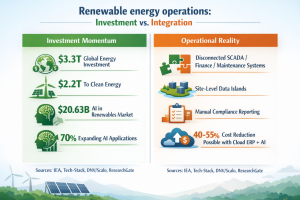
Global energy investment reached $3.3 trillion in 2025, with approximately $2.2 trillion going collectively to renewables, nuclear, grids, storage, and electrification, twice as much as the $1.1 trillion going to fossil fuels (IEA / Tech-Stack, 2025). The AI in the renewable energy market alone was valued at $20.63 billion in 2025, projected to reach $26.30 billion in 2026 at a 25.65% CAGR (Tech-Stack, 2026).
Yet most renewable operators still manage this growing complexity with systems designed for a simpler era.
Why fragmented systems create operational risk
Renewable energy firms manage vast networks of geographically dispersed assets, each generating its own data streams from SCADA, IoT sensors, weather stations, and grid interconnection points. Without a unified platform, each site becomes a data island where financial performance, maintenance history, and operational telemetry exist in separate systems that never talk to each other.
A DNV report found that 70% of digital leaders in the energy sector plan to expand AI-driven applications (Scalo / DNV, 2025). But AI can’t deliver value when the data it needs is scattered across disconnected tools. Cloud ERP provides the unified data foundation that makes AI-driven operations possible.
The cost of disconnection
Cloud ERP systems paired with AI-driven workflows can reduce operational costs by 40% to 55% while improving compliance levels by 30% (ResearchGate / AInvest, 2025). Firms investing in digital transformation report 20% to 30% reduction in operational costs and faster time-to-market for new services (StartUs Insights, 2025). 65% of renewable energy companies already use AI for predictive maintenance (Tech-Stack, 2026).
The gap is between companies that have connected their operational data into a single platform and those still reconciling spreadsheets across sites every month.
Where the industry is heading
Predictive maintenance replacing reactive repairs
65% of renewable energy companies already use AI for predictive maintenance (Tech-Stack, 2026). Wind turbine sensors detect subtle vibration changes that signal gear failures weeks in advance. Solar farm operators use drone imaging and AI analysis to identify underperforming panels without manual inspections. These techniques have reduced maintenance costs by roughly 20% while extending equipment lifespans by three to five years (Scalo, 2025).
The shift is from scheduled maintenance calendars to condition-based interventions triggered by real-time asset health data flowing through a unified ERP platform.
Digital twins for multi-site portfolio optimization
Digital twins create virtual replicas of physical assets that simulate extreme weather impact, grid stress scenarios, storage dispatch timing, and mechanical degradation patterns. Operators can test “what-if” conditions without affecting real infrastructure. In the long term, AI could cut power system costs by up to 13% by 2050 (DNV / Scalo, 2025).
Cloud-native platforms as the operational backbone
IRENA’s report on digitalization identifies five key areas where digital technologies can transform power systems: smart monitoring, AI-enhanced forecasting, operational optimization, demand response automation, and digital transparency platforms (IRENA / WEF, 2025). All five require a connected data foundation that legacy ERP systems can’t provide.
How Dynamics 365, Azure AI, and Power BI fit the energy stack
Gartner highlighted Microsoft’s integrated cloud stack, uniting Azure, Power BI, and Copilot Studio, as a defining strength in the 2025 Magic Quadrant for Cloud ERP for Product-Centric Enterprises (Gartner / CX Today, 2025).
Dynamics 365: unified financial and operational backbone
Dynamics 365 Business Central and Project Operations provide the ERP foundation that renewable energy firms need to connect finance, procurement, project delivery, and asset management. Multi-entity support handles firms operating across regions, regulatory jurisdictions, and grid operators. Job costing by project and site connects field activity to financial outcomes in real time.
For operators running solar, wind, and storage assets simultaneously, Dynamics 365 provides the single financial ledger that links a turbine’s maintenance cost to the site’s profitability and the portfolio’s return projections.
Azure AI and IoT: the intelligence layer
Azure IoT Hub ingests telemetry from SCADA systems, weather stations, and asset sensors across every site. Azure Machine Learning trains predictive models on this operational data to forecast equipment failures, optimize generation output, and predict grid curtailment events.
Azure Digital Twins creates virtual replicas of energy assets, enabling operators to simulate maintenance scenarios, capacity expansion, and weather impact before making capital commitments.
Power BI: portfolio-wide operational dashboards
Power BI embeds real-time dashboards inside the Dynamics 365 environment, unifying site-level KPIs, financial health, asset performance, and compliance status into one view. Operations teams see generation vs. forecast, maintenance backlog, and cost variance across the entire portfolio without switching between systems.
For multi-site operators, this means the COO sees portfolio health on one screen while site managers drill into their specific assets, all from the same data source.
How Advaiya helps energy firms modernize operations
Advaiya works with organizations across energy, utilities, and infrastructure on enterprise resource planning and data analytics implementations within the Microsoft ecosystem.
When Advaiya deployed a document management system for an airport, the operational challenges mirrored what renewable energy firms face with multi-site complexity: scattered documentation, manual compliance tracking, and inefficient information retrieval across distributed operations. The results demonstrated what infrastructure modernization delivers: 90%+ reduction in manual document handling, 95% compliance index, and 85% reduction in retrieval time (Advaiya Case Study Compendium).
Advaiya brings enterprise architecture expertise that connects Dynamics 365, Azure AI, and Power BI to the specific way energy operators manage distributed assets, multi-jurisdictional compliance, and project portfolios across regions.
Connect with Advaiya about energy digital transformation →