Project portfolio management in real estate is the discipline of tracking every development in a firm’s pipeline, from site acquisition and entitlement through design, construction, and handover, within a single unified view that connects financial performance, schedule status, and resource allocation across all active projects.
For real estate CTOs, this means replacing the spreadsheet-and-email approach that most developers still use. When budgets live in one file, schedules in another, and stakeholder updates happen through ad hoc phone calls, portfolio-level visibility doesn’t exist. Capital exposure stays hidden until it’s too late to course-correct.
PPM connects what’s happening on each site to how the overall portfolio is performing against investment targets. That connection is what protects IRR and keeps capital partners confident.
The operational reality: Why most developers still run blind
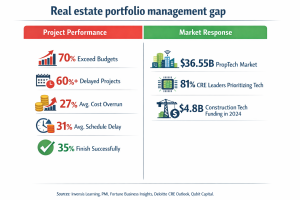
The scale of the challenge is well documented. Nearly 70% of real estate projects exceed their original budgets, and over 60% face significant schedule delays (Invensis Learning, 2026). Research shows construction projects exceed initial budgets by an average of 27%, while schedule delays average 31% (Invensis Learning / Harvard Business Review, 2026).
In 2024, more than 70% of multifamily construction providers reported significant project delays, often beginning with permitting and design approvals (Swiftlane / NMHC, 2025). Only 35% of projects worldwide finish successfully, meeting all goals and timelines (PMI / ProProfsProject, 2026).
Why spreadsheets fail at portfolio scale
12% of project investment is lost due to poor performance, amounting to trillions annually (PMI / ProProfsProject, 2026). 66% of organizations report frequent project delays caused by unclear requirements (Wellingtone / ProProfsProject, 2026). 45% of project managers spend more than one day per week manually compiling status updates (Wrike / Forbes, 2026).
When a developer is managing five to fifteen concurrent developments across different phases, the reconciliation problem becomes a critical risk. Budgets tracked in Excel can’t flag when a permitting delay on one project creates a resource conflict on another. Schedule slippage at one site doesn’t automatically adjust cash flow forecasts across the portfolio.
The market is investing in digital portfolio tools
The global PropTech market was valued at $36.55 billion in 2024, growing to $40.19 billion in 2025, and is expected to reach $88.37 billion by 2032 at an 11.9% CAGR (Fortune Business Insights / International Banker, 2025). 81% of commercial real estate leaders identified data and technology as the area where they’re most likely to focus spending (Deloitte 2025 CRE Outlook).
Construction technology alone captured $4.8 billion in 2024 funding, accounting for 32% of total PropTech investment (Qubit Capital, 2026). The investment signal is clear: real estate firms that can see their entire portfolio in real time make better capital allocation decisions.
Where the industry is heading
AI-driven cost forecasting and risk detection
AI is moving beyond generic project management into real estate-specific applications. Predictive models trained on historical project data flag potential budget overruns based on permit processing times, material price trends, and subcontractor performance patterns. The shift is from monthly reporting that shows what went wrong to continuous monitoring that catches deviations as they happen.
PwC’s Emerging Trends in Real Estate 2025 report describes the emergence of a “property operating system” combining AI agents, digital twins, and data integration layers that will allow property managers to oversee vastly larger portfolios from a single back office (PwC / ULI, 2025).
Portfolio-level visibility as an investor requirement
Institutional investors increasingly require real-time portfolio dashboards that show capital exposure, schedule risk, and return projections across all active developments. Generic project tools that track individual sites without connecting them to portfolio-level financial performance don’t meet this requirement.
Lifecycle continuity from acquisition to operations
The most damaging visibility gaps occur at phase transitions: when a project moves from entitlements to design, from design to construction, or from construction to operations handover. Data lost at each transition creates the reconciliation overhead that keeps teams in spreadsheets instead of making decisions.
How OnePlan fits the real estate portfolio stack
OnePlan was named a Strong Performer in the Forrester Wave for Adaptive Project Management and Reporting, Q2 2024, with the highest scores for integration and product roadmap (Forrester, 2024). OnePlan is Microsoft’s PPM Partner of the Year for five consecutive years, with native integration across the Microsoft 365 ecosystem.
Portfolio-level financial tracking
OnePlan connects individual project budgets to portfolio-level financial views. When a change order is approved on one development, the budget impact ripples through the portfolio dashboard automatically. Capital partners see updated exposure across all active projects without waiting for monthly reconciliation.
Resource demand planning across concurrent developments
Real estate firms running multiple concurrent developments compete internally for the same project managers, architects, engineers, and construction supervisors. OnePlan’s resource demand planning shows capacity across the entire portfolio, so staffing decisions on one project account for commitments on every other active development.
Scenario modeling for capital allocation
When a new acquisition opportunity appears, OnePlan’s scenario modeling shows how adding the project affects resource capacity, capital deployment, and portfolio risk across all existing commitments. This is the “should we take this on” analysis that spreadsheets can’t perform at a portfolio scale.
Microsoft ecosystem integration
OnePlan connects natively with Microsoft Teams for project communication, SharePoint for document management, Power BI for custom reporting, and Dynamics 365 for financial integration. Real estate teams don’t need to leave the tools they already use to get portfolio-level visibility.
How Advaiya helps real estate firms implement PPM
Advaiya works with organizations across real estate, construction, and infrastructure on project portfolio management implementations within the Microsoft ecosystem.
When Advaiya deployed Dynamics 365 Business Central for a real estate consulting firm managing 15+ business units and 1,000+ employees, the results demonstrated what unified portfolio management delivers: 80% improvement in billing accuracy, 60% reduction in approval dependency, and integration with CRM and HRMS systems that previously operated in isolation (Advaiya Case Study Compendium).
Advaiya brings enterprise architecture expertise that connects OnePlan’s portfolio capabilities to the specific way real estate development teams manage acquisitions, entitlements, design phases, construction execution, and handover workflows.
Connect with Advaiya about real estate portfolio management →