Predictive Maintenance in Chemical Plants via Cloud Analytics

Unplanned equipment downtime costs the chemical industry $20 billion annually worldwide[1], with individual incidents ranging from $260,000 to $2 million per event. Yet most mid-market chemical manufacturers still rely on reactive maintenance strategies that address problems only after they occur. Chemical plants operate in demanding environments where equipment failures can cascade into production shutdowns, safety incidents, and significant financial losses. According to McKinsey research, AI-driven predictive maintenance can reduce downtime by up to 50% and extend equipment life by 40%[2]. Cloud analytics transforms this potential into reality by enabling real-time monitoring, machine learning-based failure prediction, and proactive intervention before equipment breaks down. Why predictive maintenance transforms chemical operations From reactive firefighting to proactive prevention Chemical companies allocate 20-30% of operational budgets to maintenance, yet many still operate with strategies that fix problems after they happen. Traditional maintenance approaches fall into several categories: reactive maintenance that repairs equipment only after failure, scheduled maintenance based on fixed time intervals, and usage-based maintenance tied to operating hours or cycles. Predictive maintenance changes this dynamic by analyzing real-time sensor data to forecast when equipment will fail. This enables condition-based interventions that prevent failures rather than merely responding to them. The financial impact is substantial; organizations implementing cloud-based predictive maintenance report 25% reduction in maintenance costs and a 10-20% increase in uptime. Strategic advantages beyond cost savings Cloud analytics delivers capabilities impossible with on-premises systems. Scalable computing power handles massive data volumes from hundreds or thousands of sensors across multiple facilities. Centralized data storage enables cross-plant analysis, revealing failure patterns invisible at individual sites. Automatic model updates ensure predictive algorithms continuously improve as they learn from new data. Most of manufacturers now prioritize predictive maintenance[3], recognizing its potential to reduce downtime and extend equipment lifespans. For chemical plants facing continuous production requirements, harsh operating environments, and critical safety considerations, these advantages translate directly to a competitive position. Understanding automation in the chemical industry context helps organizations position predictive maintenance within broader digital transformation initiatives. Risk mitigation through predictive analytics Equipment failures in chemical facilities create hazards beyond operational disruption. Pressure vessel weaknesses, seal deterioration, and heat exchanger failures can trigger safety incidents with environmental and regulatory consequences. Predictive maintenance identifies these risks before they materialize, maintaining compliance while reducing incident frequency. This proactive safety management aligns with business process automation strategies that reduce human error and improve consistency across operations. Core components of cloud-based predictive maintenance IoT sensors and edge computing architecture Industrial IoT sensors capture real-time operational data from critical equipment. Vibration sensors detect bearing wear before it progresses to failure. Temperature sensors identify overheating and cooling system degradation. Pressure sensors reveal valve deterioration or blockages. Flow meters track throughput changes indicating efficiency losses. Edge computing devices process sensor data locally, reducing bandwidth requirements and enabling faster response times. Edge processing filters normal operating variations and transmits only meaningful deviations, optimizing cloud resource utilization while maintaining real-time responsiveness. Cloud data platform and analytics infrastructure Azure IoT Hub[4] handles device connectivity and secure data ingestion from thousands of sensors distributed across plant facilities. Azure Data Lake Storage[5] provides scalable storage for historical equipment data used to train machine learning models. Azure Stream Analytics[6] processes incoming data streams in real time, applying rules-based logic to identify immediate concerns. Real-time dashboards give maintenance teams instant visibility into equipment health across all facilities. This integrated approach mirrors cloud-based ERP solutions that centralize operational data for enterprise-wide insights. Machine learning models and predictive algorithms Machine learning algorithms analyze historical equipment data to identify patterns that precede failures. Azure Machine Learning[7] supports multiple analytical approaches: Anomaly detection algorithms flag unusual operating patterns deviating from normal behavior Regression models predict remaining useful life based on current operating conditions Classification algorithms categorize equipment health status for prioritization Time-series forecasting estimates when specific components will require intervention Models continuously learn from new data, improving prediction accuracy over time. When algorithms detect impending failures, they generate alerts specifying affected equipment, predicted timeline, and recommended actions. AI-powered business intelligence enhances these predictive capabilities by identifying cross-plant patterns invisible in isolated datasets. Integration with enterprise maintenance systems Predictive insights connect to existing enterprise systems, transforming analytics into operational action. Integration with computerized maintenance management systems (CMMS) automatically generates work orders when models identify equipment requiring attention. ERP connections ensure spare parts availability and coordinate maintenance with production schedules. This enterprise workflow automation eliminates manual handoffs between predictive systems and execution platforms, reducing response times and preventing coordination failures. Strategic implementation framework Phase 1: Asset prioritization and sensor deployment Start by identifying which equipment to monitor based on criticality, failure rates, and replacement costs. Critical path equipment that would halt production warrants comprehensive monitoring. Focus initial deployments on: Primary reactors and distillation columns Key transfer pumps and compressors Heat exchangers with high failure frequency Safety-critical systems with regulatory implications Chemical plant environments present unique deployment challenges. Hazardous area certifications ensure sensors meet explosion-proof requirements. Corrosion-resistant housings protect sensors from harsh chemical exposures. Wireless sensors simplify installation in hard-to-reach locations, though battery life requires consideration. Phase 2: Data platform configuration and model development Configure Azure IoT Hub to handle device connectivity across your facility footprint. Establish data pipelines that ingest sensor streams, store historical data, and feed real-time analytics. Develop baseline machine learning models using historical maintenance records combined with sensor data. Initial models should focus on high-value equipment with sufficient historical data. As models prove their predictive accuracy, expand coverage to additional asset classes. This phased approach aligns with digital transformation roadmaps that balance ambition with pragmatic execution. Phase 3: System integration and workflow automation Connect predictive maintenance platforms with existing CMMS and ERP systems. Configure automated work order generation based on model predictions. Establish escalation protocols for high-priority alerts requiring immediate attention. Develop mobile interfaces that provide field technicians with predictive insights, historical context, and recommended actions. This accessibility ensures predictive capabilities translate into operational execution rather than remaining siloed in analytics platforms. Phase 4: Change management and capability development Shifting to predictive maintenance changes
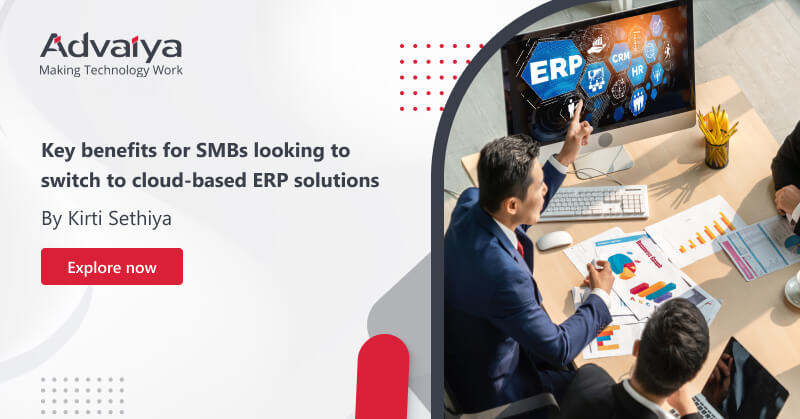
Key benefits for SMBs looking to switch to cloud-based ERP solutions
Enterprise resource planning (ERP) solutions are often used by businesses to help consolidate and organize information within an organization. ERP software was traditionally installed on company servers or other infrastructure. These on-premises solutions were able to make businesses more efficient and provide major benefits. However, they are imperfect in certain areas, such as cost, agility, and maintenance. Cloud based ERP solutions solve many of the problems that are associated with traditional on-premises solutions and provide many advantages over their counterparts on-site. The key benefits of Cloud ERP software: Lower initial cost Cloud-based ERP systems are significantly cheaper than traditional on-premises systems. Additionally, ongoing costs are often lower. The subscription costs for cloud ERP software can be reduced after deployment. This is because maintenance and support costs are typically 20% of initial license costs. These costs include hardware costs, as well as the cost to upgrade and maintain the system and IT staff. These costs can be eliminated for smaller companies that cannot afford the upfront costs of on-premises ERP, even though the technology could benefit them. Simplified compliance Businesses in highly-regulated industries such as finance, healthcare, and defense must regularly update their ERP software on-site to comply with regulations. To remain compliant and avoid expensive fees and other legal consequences, companies must be able to keep up-to-date with all the latest federal, state, and international rules updates. The company must then incorporate the changes in its existing system and upgrade hardware and software as required. Cloud ERP software providers, on the other hand, are proactive in complying with international, state, and federal provisions like HIPPA, GDPR, and GAAP. These regulations and others are already integrated into cloud ERP software. They are automatically updated to ensure businesses meet or exceed compliance requirements. Cloud ERP software often includes localization functionality, which allows companies to change between different countries’ regulations to ensure compliance across all global operations. Increased data security Business applications like ERP hold all confidential information of the company. It is, therefore, vital to keep it safe. Many people mistakenly believe that an on-site server is safer than a cloud-based one. However, this is completely false. Cloud based ERP solutions provide multiple layers of encryption to increase the security of your data and ensure that they are safely stored. Employees can access this through an individual account managed from the admin panel. Avoid the trap of ERP implementation by streamlining the deployment strategy High-profile ERP disasters are often caused by difficulties in planning and coordinating the rollout across departments and systems. On-premises ERP deployments can be a difficult and tedious task. Each department has to deal with its own problems while the IT department tries to keep up. Implementation problems can lead to production slowdowns, increased costs, and a halt in innovation. Cloud ERP software was created to address these issues directly. These systems are designed to create solutions that are more flexible, adaptable, and easier to use. Related: Six steps to a successful ERP implementation Maintenance and upgrades Businesses don’t need to worry about software upgrades or maintenance because the ERP solutions company hosts and maintains the entire system infrastructure. The provider manages all the infrastructure, including the database and servers, and pushes updates to all customers. This ensures that the software is safe and compliant with all regulations. Having one vendor handle all issues can increase accountability. Cloud ERP software providers offer 24/7 support, which is a subscription-based service. This allows them to respond quickly to any problems that may arise. Cloud ERP vendors can often provide more uptime and security for their customers than in-house IT staff because their business depends on availability. Get access to additional business intelligence capabilities Cloud ERPs make data storage and collection much simpler. This is crucial for data analysis. Many cloud-based ERPs have built-in analytics features that can be powered by real-time information. This allows your team to spot changes in business conditions, evaluate possible strategies, improve business performance, and make data-driven business decisions that reduce risk, cut costs, and increase revenue. Contrary to cloud ERPs, on-premise ERP software is more susceptible to compatibility issues and may have data silos. Cloud ERPs can easily be integrated with third-party business intelligence software if you need specific capabilities. How can cloud ERP systems help small businesses? We explained above that cloud ERP is a great option for small businesses because it is easy to use. Although ERP systems have the same benefits regardless of the size of the company, cloud ERP systems can be more cost-effective and easy to use for small businesses. Cloud ERP solutions are a great alternative to on-premise solutions that can be expensive and difficult to implement. Small businesses may not have the resources to support on-premise software. Cloud ERP software providers can be an extension of your staff, handling updates, maintenance, monitoring, and other tasks for you. This allows you to focus on the software and your business rather than worrying about how it runs. Related: Microsoft Business Central: The next step for SMEs Better agility for your business A growing business needs agility. Companies must be able and willing to take advantage of opportunities such as new locations, new products, services, acquisitions, and responding to market changes. Cloud ERP systems allow companies to expand their business by providing instant access to data from all departments. Cash flow visibility in the cloud Any growing company needs cash flow to survive. Cloud ERP software integrates accounting processes with business operations to increase information availability, such as working capital, operating costs, and investments. This ensures that every aspect of the company is accurately accounted for, which ultimately leads to growth. Seamless integration in the cloud To keep up with consumers and market demands, small businesses must adapt frequently. Cloud-based ERP solutions like Dynamics 365 Business Central simplify the integration of new software, processes, and solutions. This helps with frequent adjustments. Are you ready to make the switch to a cloud ERP? Advaiya can help. Cloud migration brings better best-practice data, new
Cloud is Good

Cloud is good! Shared computing services—whether applications or platforms—available over internet have granted unprecedented access to technology sophistication to small and medium sized businesses. The potential inherent in information technology has been immense and the possible impacts are only getting more pronounced. Technology not only bolsters efficiencies, but also influences fundamental changes in the business models themselves. But getting technology to work for a particular business has traditionally been arduous, requiring significant expense, effort and skills. As such, access to “enterprise-class” has been limited to large businesses who can afford to invest for required application sophistication, reliable deployment and operational support. Cloud changes this in a fundamental way. It allows the businesses access to the benefits of technology without worrying about (most of) the underpinnings—building, deploying, operating, maintaining, and investing. Thus the businesses can focus on what technology can deliver, rather than delivering technology. This is great news for small and medium businesses. Let’s see how: Choice: The sheer ease with which businesses can explore, assess and select various options on cloud is breathtaking. Be it messaging, collaboration, accounting, CRM, or any other application—businesses have enormous choice. Compared to the traditional on-premises technologies, cloud affords the ability to try at much lesser costs and commitment. A vibrant community of users can also be quite helpful. Costs: Cost savings could be a big advantage to SMBs as they adopt cloud. These savings accrue primarily because cloud services are charged based on usage. Thus, costs of idle resources or over-capacity are saved. Further, as cloud involves mostly op-ex rather than cap-ex, it can be much more cash flow friendly for an SMB. On demand nature of cloud services mean that the business would not need to carry costs of computing resources no longer in need. Speed: SMBs can ill-afford large deployment or upgrade projects and cloud dramatically reduces time taken to provision, setting up services and making applications available. Also, cloud absolves businesses of intensive efforts required to upgrade to newer versions. System patches and upgrades, typically, happen in the background with user impact reduced to the minimum. Access: SMB’s also need 24/7 access to their applications and data regardless of location or device. Increasingly, businesses rely on their mobile devices (phones or tablets) while on the move or even at the workplace. While cloud applications, by definition, are available anywhere and at all times, growing consumerization and democratization of internet access (less reliance on corporate networks) are driving cloud application providers to be more available and accessible. Thus cloud applications are much more likely to be available (or at least compatible) for a variety of devices—operating systems, browsers, or form-factors. Scalability: It is one of the more fundamental promises of cloud. Vast computing resources shared across a variety of users enable scalability—availability of computing capacity (be it computing power, storage, number of users, etc.) on demand. From a business’s perspective, usage based pricing allows valuable flexibility. Thus making available an IT environment which is dynamic and fluid with the ability to add new businesses, spin up new services and respond to the ever changing customer needs. Performance and support: Most cloud service providers design their offerings and are set-up to certain standards for reliability, availability and performance. In contrast, IT infrastructure and set-up at many SMBs has grown organically and thus end up being difficult to manage with clear performance expectations. Most cloud providers offer service level agreements (SLA’s) which can include parameters such as application performance, availability, datacenter uptime, host failure and migration, etc. Further, support is typically available 24×7 to assist with issues, and other such events. Standardization and Integration: Increasingly cloud services are adopting common standards—be it for data representation, application interfaces or for underlying aspects of identification and authentication. This has led to possibilities for SMBs wherein they can leverage a diverse selection of technologies to suit their needs best, and still enjoy a level of integration, single sign-on, etc. Of course, it is considerably easy to enable integrated experience if the cloud applications belong to one platform or family, still there is a growing number of integrating services and options that may be used. Skill Needs: Managing IT, even in an SMB, could be very effort intensive. As number of applications, users and complexity grows, a diverse and relative large set of professionals (whether outsourced or as full-time employees) may be needed. This can include administrators, database experts, network administrators, application developers, hardware technicians, support personnel, etc., apart from technology managers and architects. This could be daunting for most SMBs. The portfolio of technology skills needed with cloud adoption changes for the better. Cloud enables a business to focus on the purpose and direction of IT—whereas much of the operational, maintenance and support aspects are responsibilities of the cloud service providers. Security: Contrary to popular perception, cloud applications can be much more secure, especially for small and medium businesses. It is a fact that ensuring security is hard. The applications and infrastructure need to be continuously monitored, maintained, patched; in general remain ahead of looming cyber threats. That requires enormous expertise and expense, which a small or medium sized business might not want to organize. Similarly, more basic threats to application and information availability like power or network outages, simple human errors, hardware failures, etc., are much better addressed when specialized cloud service providers bring together scale, skills and investments. Also, reputable cloud application providers have, in general, invested significantly in compliance to security standards, operational best practices, infrastructure redundancies and people preparedness. Technology Innovation: Much of the new technology development is happening in the realm of cloud. Technology companies like Microsoft have adopted cloud as primary focus, whereas offerings from companies like Google or Amazon have been almost entirely cloud based. Many innovative startups who are enabling new use cases and applications are building those for cloud. Be it newer ways of connecting to customers, or more efficient collaboration with an organization—some of the most innovative tools are available as cloud only. No business
Five must-haves to evaluate cloud backup & disaster recovery providers

With the increasing amount of data processing and a wide variety of application usage, data protection has become a critical component in the IT strategy of every business. Even the slightest of downtime can significantly impact productivity. Therefore your daily operations can be compromised if you fail to recover your precious data quickly in the event of a natural disaster, storage failure, or cyber-attack. A vast majority of companies are aware of the importance of data protection. However, nearly 3 out of 4 companies worldwide are failing in terms of disaster readiness, according to the Disaster Recovery Preparedness Benchmark Survey, 2014. While cloud backup disaster recovery providers often offer affordable, reliable, and efficient data protection solution for companies, choosing the right service for your specific business needs can be a challenge. So, before you implement your backup and DR strategies in cloud, here are five things you need to take into consideration when evaluating cloud backup providers. 1. Experience – DR budget typically ranges from 5-7 percent of the total IT budget. Hence, finding a cloud backup service provider that has the capability to meet specific requirements of your organization and the one who has got the expertise to work within the available budget is important. 2. Testing Recovery– Testing recovery operations is an essential ingredient when selecting a service provider offering DRaaS/BaaS capabilities. It is recommended to perform an initial test at the provider’s location before you sign a contract with the provider to bring up any impending issues that might occur during the test. Varying infrastructural differences may confine you to work within the boundary of the provider’s cloud which may force you to redesign your infrastructure from scratch. 3. SLA – When considering SLA, you should be careful of even the minutest detail of service that your service provider is providing. Before signing up with any backup as a service (BaaS) or disaster recovery as a service (DRaaS), verify to read the fine print in the SLA. If something is not explicitly written into the SLA, you should not assume that it is a covered service. 4. Security – Some providers encrypt data at rest on their servers, but not data in transit. It is recommended that data should be encrypted at no less than 256-bit AES (Advanced Encryption Standard) levels before it leaves the customer's site for the cloud provider so that the data in transit cannot be stolen as plain text. The companies should hold all encryption keys and not allow the BaaS or DRaaS provider to have the ability to decrypt any data stored on their servers. 5. Compliance – As cloud-based storage today has become a commodity, hence, providers might tend to store your data on inexpensive storage having poor security. So, if your data backup pertains to government or industry related security regulations, you must ensure that the data centers where your backups are stored, meet the required compliance standards. For example, customers' health should be stored in HIPAA-compliant (Health Insurance Portability and Accountability Act) clouds and credit card data should be stored in PCI DSS-compliant (Payment Card Industry Data Security Standard) clouds. In short, SMBs who tend to do all the recovery themselves may miss some essential requirements. Hence, having a key person at the provider side should help eliminate those errors. However, it is highly recommended that you do your due diligence to ensure that the provider you choose for cloud backup disaster recovery services, can assist in the recovery of files in a right way while providing technical support and assistance as and when needed.
Major concerns for Cloud Computing in respect of Office 365

As a Microsoft partner for Office 365 and Azure solution implementation, we often come across customers who are either planning to migrate some of the workload to Office 365 or started some proof of concepts for selective workloads in cloud, but worry of adopting cloud as primary workload or infrastructure. This situation is mostly prevalent in small and medium sized organization where IT must justify security, privacy and compliance concerns to business leaders and decision makers that their data is safe. Also, we have come across similar concerns for large organizations where they have matured into identifying general cloud concerns for a SaaS or PaaS based platform and how to evaluate for a specific vendor. We try to evade all these concerns and doubts because for most of the organizations this is paradigm shift for extending some part of their infrastructure on cloud. Some of the major questions asked are – Is our information secure? Who can access it? What are the data privacy policies? How do these policies translate on how we manage and store our data in the cloud? Let’s dive into the answers which are specific to Office 365. Data ownership and protection Most important question is related to data ownership and protection of data on office 365 – like who has access to my data, where my data is stored, who owns my data. Where my data is stored? Microsoft Office customers know where their customer data is stored and the location of their datacenters around the world. Each of our business cloud services has specific data residency and transfer policies. The customer’s country or geo, which the customer’s administrator input during the initial setup of the services, determines the primary storage location for that customer’s data. So, in case if a customer’s primary office is in India then datacenter will reside in India. You can check more information on geos and location here. This site lists all geos and location of data for all types of Microsoft online services. Who owns my data? If you put your money in a bank who owns your money? You. Bank is just managing money on your behalf. In same way, you own your data For Microsoft, your data is your business. Microsoft does not share business customer data with our advertiser-supported services, nor do we mine it for marketing or advertising. This policy is backed by our agreements and reaffirmed by the adoption by many Microsoft services of the world’s first international code of practice for cloud privacy, ISO/IEC 27018. What happens to my data if I leave the service? Based on Online Services Terms, Microsoft contractually commits to specific processes when a customer leaves a cloud service or the subscription expires. This includes deleting customer data from systems under Microsoft’s control: If you terminate a cloud subscription or it expires (except for free trials), Microsoft will store your customer data in a limited-function account for 90 days (the “retention period”) to give you time to extract the data or renew your subscription. During this period, Microsoft provides multiple notices, so you will be amply forewarned of the upcoming deletion of data. After this 90-day retention period, Microsoft will disable the account and delete the customer data, including any cached or backup copies. For in-scope services, that deletion will occur within 90 days after the end of the retention period. (In-scope services are defined in the Data Processing Terms section of our Online Services Terms.) How I would get my data if you go out of business or I terminate the contract? For Microsoft partners and reseller this is a common question – If a partner or reseller goes out of business, customer can change partner or reseller as their services are governed under contract with Microsoft. In case customer does not want to continue online services like Office 365 with Microsoft they have ample time to get backup or migrate their data to other services after subscription termination as described in above question. Who can access my data? During the term of your subscription to Microsoft business services, you can access and extract your customer data. Customers of Azure, Dynamics 365, Intune, and Office 365 in-scope services can retrieve a copy of their customer data at any time and for any reason without the need to notify Microsoft or ask for assistance. Microsoft limits access to customer data by deploying several measures and processes that falls under two categories – physical and logical Access to physical datacenter facilities is guarded by outer and inner perimeters with increasing security at each level, including perimeter fencing, security officers, locked server racks, multifactor access control, integrated alarm systems, and around-the-clock video surveillance by the operations center. Access to customer data is restricted based on business need by role-based access control, multifactor authentication, minimizing standing access to production data, and other controls. Access to customer data is also strictly logged, and both Microsoft and third parties perform regular audits (as well as sample audits) to attest that any access is appropriate. In addition, Microsoft uses encryption to safeguard customer data and help you maintain control over it. When data moves over a network—between user devices and Microsoft datacenters or within datacenters themselves—Microsoft products and services use industry-standard secure transport protocols. To help protect data at rest, Microsoft offers a range of built-in encryption capabilities. Microsoft engineers do not have default access to cloud customer data. Instead, they are granted access, under management oversight, only when necessary. What happens if you get a request from local, state or federal government to access my data? In the case of government surveillance, Microsoft has taken steps to ensure that there are no “back doors” and no direct or unfettered government access to your data. Microsoft impose carefully defined requirements for government and law enforcement requests for customer data. Microsoft will not disclose data hosted in Microsoft business services to a government agency unless required by law. If Microsoft is compelled by law to disclose
Enterprise-level innovation is democratized and available for SMB

Trends relating to cloud, mobility and data driven collaboration mean that SMBs can be every bit as sophisticated and cutting edge as large enterprises.
Spending too much time troubleshooting IT issues?

How many calls or requests in a week do you think the help desk receives related to infrastructure? How long do you think the help desk spend working on these issues? Apparently, more than you think. Managing day to day IT operations hold the IT team to focus on the core business. In other words, if you’re just solving the problems and not planning to prevent them, you will always have to keep solving them. Reasons could be relying on old technologies for running your operations and not because you do not want to upgrade. The business-critical system of your company cannot afford the downtime of transition to newer technologies. But on the other side, this causes slower performance, troubleshooting, and costs time and money. Also, there might be a situation that you are spending much on barely used systems. The IT team keep maintaining multiple legacy systems and doing this adds a layer of complexity to the infrastructure. But again, when the problem arises it become harder to spot a problem which again needs a lot of efforts. Chances are your company falls into at least one of these categories and is wasting at least some part of its IT budget. And all these problems come from the same place: You’re not getting enough return on your infrastructure investments. So, is it the right time for you to move your infrastructure to Cloud? Today users are becoming increasingly demanding: they want useful resources more quickly than ever, and they want to be able to access services whenever they want. It is not about the size of the company; it is all about the speed at which your business operates. A decision to move to the cloud gives organizations enormous advantages Lower cost It saves a lot of up-front costs related to hardware and human resources. You simply pay for what services you use. So, less budget for IT infrastructure and more focus on actual business problems. Faster and up-to-date setup It can typically be deployed in a matter of days as there is no need to install software or hardware on-site. Also, you do not have to worry about the system maintenance and upgrades. On demand availability It gives you the agility to scale up and down with growing or fluctuating demands. Also, it offers flexibility for employees to access the company resources and work from almost anywhere. So, considering these points, and the benefits that the cloud can provide to your organization, I think this is the right time for you to move to the cloud. We are Value Added Reseller (VAR) of major cloud services providers, we bring together consulting, migration, operations and licensing services enabling you to adopt cloud technologies in the most fruitful manner seamlessly. Call us today at +1-425-256-3123 or Email us at connect@advaiya.com to discuss your challenges and see how we can help.
Facing unplanned downtime and reduced productivity?

Despite developments in infrastructure robustness, organizations still face software, hardware, network, and database downtime, ranging from short periods to closing the business for days. Unplanned downtime has been impacting companies in multiple ways: Reduce profitability – this is the most direct effect Harm business reputation and loyalty Compliance impacts – if you have SLA’s or performance guarantees, 100% response times to your customers Potential remedial costs – overtime costs to recover the work lost All these negatively affect your organization’s performance and productivity. 100% uptime is crucial for organizations today, which depends on IT both for employee productivity and a competitive differentiation to stay ahead. So how can you prevent unplanned downtime and hampered productivity? Choosing an infrastructure solution that best suits your business needs The right cloud strategy promises a lot: Minimal recovery time – With cloud-based disaster recovery, the backup environment will be ready to serve your mission critical applications the moment any incident is detected at the primary sites. Once end-users have been transferred to the cloud environment, organizations can get to work repairing the primary site rapidly to cut the amount of time spent utilizing the recovery site. Compliance and security solutions – Cloud vendors stay up to date with the state-of-the-art industry standards and compliance certifications. Single-tenant cloud users enjoy an additional layer of security as there’s no chance of their data being compromised, accessed by unauthorized users or mixed with another company’s data. Elastic infrastructure – Cloud-based services are ideal for businesses with growing or fluctuating demands. The cloud provides the agility to easily scale up as demands grow, and scale down again as per the need. So, the customers can add more users, storage, and features over time. The benefit of this flexibility is that companies only have to pay for what they need and use. Reduced CAPEX – Cloud computing helps bring down the high cost of infrastructure. The pay-as-you-go option allows for a subscription-based model, where you only pay for services procured rather than overbuying resources. Not on the cloud yet? If you are looking to protect your IT environment and shorten the backup and recovery time, we can help you move to the cloud. As Value Added Reseller (VAR) of major cloud services providers, Advaiya brings together consulting, migration, operations and licensing services enabling you to adopt cloud technologies in the most fruitful manner seamlessly.
10 reasons to move your infrastructure to Microsoft Azure

Microsoft Azure is the core of Microsoft’s Cloud offering, and it’s getting more and better received each year. In the final quarter of 2016 alone, Microsoft has reported a whopping 102% growth in Azure revenue, with usage doubling year after year. As we look towards 2017, we’ve picked our top 10 reasons organizations are moving to the cloud. 1. Agile and scalable Business growth is often unpredictable. For your IT platforms to provide the most value, they need to be able to grow and scale as your business does. Azure shines at this, allowing you to develop applications as a cluster that designates a web application to a set of specific set of processes. With applications spread across multiple of servers, they won’t run out of server capacity. 2. Microsoft compatibility For any organization currently using Microsoft products like SharePoint and Office 365, a cloud infrastructure provider that works seamlessly with existing technology is vital. Microsoft Azure is in a unique position to offer that ease of use to organizations, over providers like AWS. The same Virtual Machines can also be used on-premises, further simplifying processes. 3. On-demand computing Vast amounts of computing resources can be provisioned in minutes, typically with just a few mouse clicks, giving businesses a lot of flexibility and taking the pressure off capacity planning. 4. Elastic hosting With the complex range of computing and software options available on the market, flexibility is vital. Azure offers Infrastructure as a service option, allowing organizations to outsource their cloud infrastructure (to us for instance) and follow a pay-as-you-go, model. 5. Secure and resilient Microsoft is one of the most renowned, long-standing technology companies out there and has proved their capability in the enterprise space many times over. For many organizations where security and reliability are critical, this is a big selling feature of Azure. Data is also safe, with Azure based on the Microsoft Security Development Lifecycle, a highly advanced approach to developing the most secure code. 6. Global data centers For global organizations with employees located in several countries, local data centers to improve speed and uptime are important selling points of a cloud infrastructure provider. Azure is backed up by Microsoft’s growing number of global managed data centers; there are currently 30 with eight additional regions including Korea, France, and four more locations in the USA coming soon. From a user’s point of view, their experience is also hugely improved by having a local data center. 7. Hybrid capability Azure also gives users the choice to build hybrid environments, allowing organizations to leverage on-premises resources and the advantages of the cloud without complexity. 8. Economies of scale Azure’s pay-as-you-grow model decreases unnecessary costs as you’re only paying for what you use. With their large customer base, they have also been able to pass on volume discounts to their clients. 9. Simplified management Even though the Azure platform has been around for many years now, the services that it offers have been continuously evolving, offering new features to consumers. It has not been standing still from a management point of view either, and the IT professional now has a much more superior API to use in the form of Azure Resource Manager (ARM). 10. Support From small dev-test projects to global product launches, Azure is engineered to handle any workload. Azure also offers enterprise-grade SLAs on services, 24/7 tech support, and service health monitoring. Microsoft also provides support in a variety of languages to help the regions of their data centers. We work with clients every day to build business cases for Azure, consulting on the best strategies for cloud infrastructure that will add value. Look here for more info on the cloud infrastructure services we offer and feel free to contact us to discuss your requirements. Want information about our Cloud infrastructure services? Click here