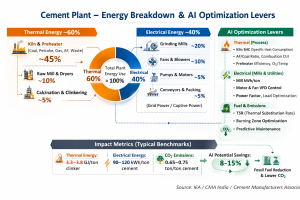
Cement manufacturing is one of the most energy-intensive industrial processes. A rotary kiln sustains 1,450°C+ to produce clinker. The finishing grinding process consumes 30–40 kWh per ton. Together, kiln thermal energy and electrical loads make energy the single largest cost, 30–40% of production expenses (IEA).
AI-driven kiln optimization changes how that cost is managed. ML models trained on thousands of process variables, raw mix chemistry, burning zone temperature, fuel calorific value, preheater pressures, and cooler grate speed adjust set points continuously. Unlike rule-based DCS logic, AI identifies non-linear relationships and responds faster than any operator.
McKinsey[1] found that AI in autonomous mode delivered up to 10% throughput and energy efficiency improvement at a North American cement plant (McKinsey). Titan America’s Pennsuco facility achieved 6% electrical energy reduction while doubling alternative fuel usage. Yet not a single cement plant has achieved “lighthouse” status in WEF’s digital manufacturing network (WEF).
For manufacturers still on legacy DCS with manual adjustments, the efficiency gap compounds every quarter.
Why the energy problem is structural
Cement accounts for ~7% of global CO2 emissions. The IEA’s Net Zero scenario[2] requires 4% annual CO2 intensity declines through 2030. India’s cement market is projected to reach $23.4 billion by 2029 at 6.2% CAGR, volumes climbing even as decarbonization pressure intensifies.
The challenge spans three operational layers:
- Kiln thermal efficiency. SHC in most plants ranges from 3,000–3,500 MJ/ton of clinker. Excess air wastes fuel; too little causes incomplete combustion. AI optimizes this balance continuously, something manual control can’t sustain across shifts.
- Clinker ratio reduction. Substituting GGBS, fly ash, or calcined clay reduces energy and emissions per ton. But variable SCM quality demands real-time process adjustments that manual control can’t deliver consistently.
- Grinding energy. Finish grinding consumes 60–70% of plant electricity. AI adjusts separator speed, pressure, and feed rate to minimize kWh/ton while maintaining Blaine targets, preventing over-grinding that wastes power.
Where plant data infrastructure breaks down
54% of I&O leaders cite cost optimization as their top AI goal (Gartner, October 2025). In cement, the data foundation typically isn’t ready.
Most plants have data locked in isolated historians, manual logs, or aging DCS that don’t communicate. CMA India notes that while majors like ACC (Plants of Tomorrow/PACT system), UltraTech (Expert Optimiser), and Ambuja (Blue Yonder) have invested in integrated digital infrastructure, the broader industry still runs fragmented systems.
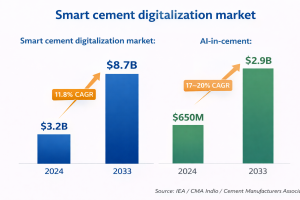
The smart cement digitalization market, $3.2B in 2024, is projected to reach $8.7B by 2033 at 11.8% CAGR (Research Intelo[3], 2025). Traditional optimization has hit its ceiling.
How the industry is moving: from advisory to autonomous AI
Gartner’s 2025 AI Hype Cycle positions AI agents and AI-ready data as the two fastest-advancing technologies, both directly applicable to cement (Gartner, 2025[4]). The progression:
Stage 1: Connect and collect. IoT sensors on kilns, preheaters, coolers, and mills. Unified cloud platform. Baseline energy benchmarks per ton of clinker.
Stage 2: Predict and visualize. Dashboards flag efficiency drift. Models forecast free lime excursions and detect early refractory wear.
Stage 3: Closed-loop AI. Active adjustment of fuel feed, kiln speed, air flow, separator speed, and grinding pressure continuously, without operator input. This is where McKinsey measured the 10% gain.
Stage 4: Enterprise integration. Process AI connected to ERP for real-time cost tracking, procurement triggers, and maintenance scheduling from equipment health scores.
Most plants are at stage one or two. Competitive advantage compounds at stage three.
The technology stack that makes it work
Azure IoT Hub ingests real-time sensor telemetry from kilns, preheaters, mills, and coolers, connecting existing SCADA/DCS via OPC UA without replacing infrastructure.
Databricks on Azure trains process optimization models on historical plant data. Its lakehouse architecture handles sensor time-series volume while enabling process engineers and data scientists to collaborate.
Azure Machine Learning deploys trained models to the edge for real-time inference at process-control speed.
Power BI surfaces the intelligence: SHC trends, mill kWh/ton, alternative fuel TSR, and clinker factor dashboards, giving plant managers and CXOs visibility into where energy is consumed and where optimization delivers.
How Advaiya helps cement manufacturers get there
Advaiya’s business analytics practice connects fragmented plant systems to a centralized intelligence platform on the Microsoft stack.
When Advaiya built a unified data platform for a conglomerate spanning manufacturing and infrastructure, the challenge was identical: no unified data estate, complex compliance, and demand for measurable outcomes. Results: 20% energy efficiency improvement, 10,000+ tons of carbon emissions reduced, 300+ automated validation workflows (Advaiya Case Study Compendium).
Advaiya works across the manufacturing value chain from Azure and Databricks infrastructure through Power BI dashboards for plant managers and CXO reporting.
Talk to Advaiya about cement plant analytics →