Smart factory transformation is the shift from static, hardware-bound production control to adaptive, software-defined manufacturing where AI continuously learns from sensor data, adjusts process parameters in real time, and surfaces operational intelligence that human operators can act on or that autonomous systems act on without human intervention.
For manufacturing CTOs, this isn’t about adding another dashboard to the plant floor. It’s about connecting the data streams that already exist from PLCs, SCADA systems, quality inspection stations, energy meters, and supply chain feeds into an intelligence layer that turns 1,812 petabytes of annual manufacturing data (Deloitte) into decisions that reduce downtime, cut energy waste, and improve yield.
The challenge isn’t generating data. It’s making it actionable at the speed production demands.
The operational reality: Why most factories are still running on fragmented data
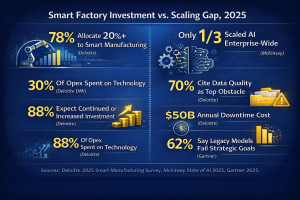
The investment appetite is real. Deloitte’s 2025 Smart Manufacturing[1] Survey of 600 executives found that 78% allocate more than 20% of their improvement budget to smart manufacturing initiatives, and 88% expect investments to continue or increase in the next fiscal year (Deloitte, 2025).
Technology spending is rising fast. Manufacturing companies[2] dedicated 30% of their operating budget to technology in 2024, up from 23% in 2023, with cloud, generative AI, and 5G delivering the highest ROI (Deloitte Digital Maturity Index, 2024).
But scaling remains the bottleneck. McKinsey’s State of AI 2025 report found that 88% of organizations use AI in at least one business function, yet only about one-third have scaled it across the enterprise (McKinsey, 2025). Nearly 70% of manufacturers say data quality, contextualization, and validation are the most significant obstacles to AI implementation (Deloitte, 2025).
The cost of inaction is measurable. Unplanned downtime costs manufacturers globally over $50 billion annually (Deloitte, 2024). Poor maintenance strategies alone can reduce a plant’s overall production capacity by 20% (Deloitte). And in energy-intensive sectors like cement manufacturing, where energy costs represent roughly 40% of total production cost, even a 5% improvement in kiln thermal efficiency or clinker ratio optimization translates directly to margin.
Meanwhile, 62% of CIOs say their legacy operating models fail to support strategic goals (Gartner, 2025). The gap between investment intent and operational reality is where most manufacturing AI initiatives stall.
Where the industry is heading
Three capabilities are defining the next generation of manufacturing operations.
The first is predictive maintenance, moving from pilot to plant-wide deployment. McKinsey estimates predictive maintenance can cut downtime by up to 50% and lower maintenance costs by 15–30% (McKinsey, 2025). Deloitte found that companies adopting AI-driven predictive maintenance reduce equipment breakdowns by up to 70% (Deloitte / Prolifics, 2025). A 2025 Gartner report projects that 70% of manufacturers will adopt AI-driven predictive maintenance by year-end, up from 45% in 2023 (Gartner, 2025).
The second is AI-powered process optimization, particularly in energy-intensive operations. In cement manufacturing, AI-driven kiln optimization adjusts feed rates, fuel injection, and air flow in real time based on clinker quality targets and thermal efficiency readings. The same principle applies across heavy manufacturing: AI models trained on process historian data identify parameter combinations that reduce energy consumption, improve yield, and minimize waste continuously, not quarterly.
The third is the convergence of digital twins, edge AI, and unified data architectures. Digital twins can slash maintenance costs by up to 40% while boosting asset uptime 5–10% (McKinsey). Edge AI processes sensor data locally for millisecond-level response times. And unified namespace (UNS) architectures standardizing data from legacy PLCs, modern IoT sensors, and enterprise systems into a single contextual layer are replacing the fragmented data silos that have limited factory intelligence for decades (Cognizant, 2026).
How Azure AI, Databricks, and Power BI fit manufacturing’s intelligence stack
The Microsoft and Databricks ecosystem provides the infrastructure layer that manufacturing AI initiatives require, from data ingestion and model training through operational dashboards and edge deployment.
Azure IoT Hub and Azure Digital Twins connect factory-floor sensors, PLCs, and SCADA systems to the cloud, creating the real-time data pipeline that feeds predictive maintenance models, process optimization algorithms, and quality inspection AI. For plants with legacy infrastructure, Azure IoT Edge runs inference models locally, delivering millisecond response times without requiring full cloud connectivity.
Databricks provides the lakehouse architecture where manufacturing data, process historian logs, energy meter readings, quality lab results, and supply chain feeds get unified, cleaned, and contextualized. This directly addresses the data quality problem that 70% of manufacturers cite as their top AI obstacle. For cement plants, this means combining kiln temperature profiles, raw meal composition data, GGBS blending ratios, and energy consumption logs into a single analytical environment.
Power BI delivers the operational visibility layer. Real-time dashboards surface OEE trends, energy consumption per ton, predictive maintenance alerts, and quality metrics, giving plant managers and CTOs the same view of operations without waiting for shift-end reports. When connected to Databricks-trained models, Power BI dashboards don’t just report what happened. They predict what’s about to happen.
Together, this stack turns fragmented factory data into continuous operational intelligence, the foundation for scaling AI from pilot to plant-wide.
How Advaiya helps manufacturers build AI-ready operations
Advaiya works with organizations across manufacturing, energy, and infrastructure on data and AI implementations within the Microsoft ecosystem.
When Advaiya built an ESG reporting board for a diversified conglomerate tracking 20+ KPIs across 300+ data validation workflows with 90%+ reduction in manual work and a 95% data quality index, the challenge mirrored what manufacturers face: unifying fragmented data sources, ensuring data quality across operational systems, and delivering real-time visibility to leadership (Advaiya Case Study Compendium).
Advaiya brings enterprise architecture expertise that connects manufacturing process requirements to Azure, Databricks, and Power BI configuration so the intelligence stack reflects how your plant operations, maintenance, quality, and energy management teams actually work.
Connect with Advaiya about manufacturing AI →