R&D portfolio management in pharma is the strategic discipline of deciding which drug candidates get funded, which get killed, and how resources flow across a pipeline spanning dozens of therapeutic areas and development stages.
It sits above individual program management. A CTO stops asking whether a specific Phase II trial is on schedule and starts asking whether the overall portfolio is balanced for risk, aligned with therapeutic strategy, and financially sustainable against the patent cliff ahead.
With $300+ billion in annual R&D spending industrywide and over 10,000 drug candidates in clinical development globally (Clinical Leader / Evaluate, 2025), the difference between disciplined portfolio management and spreadsheet-based decision-making is measured in billions.
The economics forcing portfolio discipline
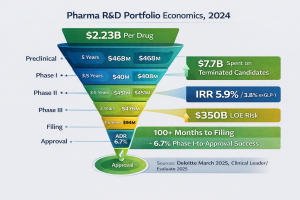
Deloitte’s 15th annual pharmaceutical innovation report[1] found that the average cost to develop a drug reached $2.23 billion in 2024, up from $2.12 billion the prior year. Costs rose at 12 of the 20 largest companies tracked (Deloitte, March 2025).
Development time from Phase I through regulatory filing now exceeds 100 months, a 7.5% increase over five years. Phase III cycle times alone increased by 12% (Deloitte, 2025).
Attrition makes those numbers worse. The Phase I-to-approval success rate fell to 6.7% in 2024, down from 10% a decade ago (Clinical Leader / Evaluate, 2025). The top 20 companies spent $7.7 billion on clinical trials for candidates that were ultimately terminated in 2024 (Deloitte, 2025).
Returns tell a fragile story. R&D’s internal rate of return rose[2] to 5.9% in 2024, recovering from a record low of 1.2% in 2022. But strip out GLP-1 therapies and the IRR drops to 3.8% below the cost of capital for most companies (Deloitte, 2025).
Crowding compounds the problem. 37% of all late-stage assets sit in oncology, with 90% of the top 20 competing in the space (Deloitte, 2025). And an estimated $350 billion in revenue faces loss-of-exclusivity risk between 2025 and 2029 (Evaluate, 2025).
Replenishing pipelines while protecting existing revenue is fundamentally a portfolio management decision.
Where the industry is heading
Three shifts are reshaping how pharma manages R&D portfolios.
The first is the move from spreadsheets to platform-based portfolio intelligence. As World Pharma Today reported in 2025, most pharma R&D functions still manage portfolios across multiple spreadsheet files, maintained by different people, updated on different schedules, containing different versions of the same data.
Decisions get made on inconsistent information. Scenario analysis happens as an annual exercise, not a continuous capability. Decision rationales go undocumented. The industry is moving toward integrated platforms that create a single source of truth (World Pharma Today, 2025).
The second is AI-guided portfolio prioritization. Deloitte found that 42% of global C-suite life sciences executives saw moderate or significant financial ROI from generative AI in the past year (Deloitte, 2025). PwC’s 2026 future of pharma analysis calls for AI-guided portfolio management that dynamically rebalances investments as science evolves (PwC, January 2026).
The third is the convergence of pipeline strategy with financial and resource planning. With biopharma venture investment rebounding to roughly $26 billion in 2024 (PwC, 2026) and industry revenue projected to reach $1.7 trillion by 2030 at a 7.5% CAGR (Clinical Leader, 2025), portfolio decisions must connect therapeutic strategy to financial forecasts, manufacturing capacity, and workforce planning in a single decision environment.
How OnePlan fits pharma’s portfolio management requirements
OnePlan is a strategic portfolio and work management platform built on the Microsoft cloud. Forrester recognized it as a “Strong Performer” in the Wave for Strategic Portfolio Management, Q2 2024, with the highest possible scores in integration and roadmap criteria. Microsoft has named OnePlan a Partner of the Year for PPM five consecutive years.
Pharma clients include Organon, BioMarin, and Generate: Biomedicines.
Three capabilities map directly to what pharma R&D needs.
Scenario modeling lets portfolio teams test what happens if a late-stage asset fails, if a competitor launches first, or if resources shift from overcrowded oncology to underinvested neurology. OnePlan enables the continuous “what-if” capability the industry increasingly requires, not annual spreadsheet exercises.
Resource demand planning surfaces capacity constraints across clinical operations, regulatory affairs, CMC, and commercial readiness before those constraints delay timelines. When the same biostatistics team is needed for three concurrent Phase III readouts, OnePlan shows the conflict at the portfolio level.
Financial planning connects pipeline investment decisions to budget forecasts. R&D leadership sees how portfolio composition affects spend, projected returns, and capital allocation across therapeutic areas.
OnePlan integrates natively with Microsoft Teams, Power BI, Azure DevOps, and Project for the web, alongside Jira, Smartsheet, and monday.com. Its Sofia GPT capability uses Microsoft OpenAI for AI-assisted resource forecasting.
How Advaiya helps pharma organizations implement portfolio-level visibility
Advaiya works with organizations across pharma, manufacturing, and infrastructure on project and portfolio management implementations within the Microsoft ecosystem.
When Advaiya deployed an ESG reporting board for a diversified conglomerate tracking 20+ KPIs across 300+ data validation workflows, the results mirrored what pharma R&D needs: 90%+ reduction in manual work, 95% data quality index, and 90% reduction in project setup time (Advaiya Case Study Compendium).
Advaiya brings enterprise architecture expertise that connects portfolio management strategy to platform configuration so the tool reflects how your R&D, clinical, regulatory, and commercial teams actually make pipeline decisions.
Connect with Advaiya about pharma portfolio management →