RFP and bid management in AEC architecture, engineering, and construction is unlike business development in any other industry. Every pursuit requires coordination across disciplines that rarely share tools or timelines: structural engineers drafting technical approaches, estimators building cost models, marketers assembling resumes and project sheets, and principals reviewing win strategy, all against deadlines that routinely land on a Friday afternoon.
A single firm might submit 415 proposals in a year and win roughly half (Unanet, 2025 AEC Inspire Report). Each submission involves pulling credentials, formatting deliverables, routing approvals, and ensuring compliance with page limits, section orders, and evaluation criteria that vary by client and procurement type: CMAR, design-build, design-bid-build, or qualifications-based selection.
When RFP tracking lives in email, project sheets sit in shared drives, resumes exist in individual Word files, and bid status updates happen in spreadsheets, firms don’t have a proposal problem. They have a visibility problem that costs them work.
The operational reality: Why firms are losing bids to process, not competition
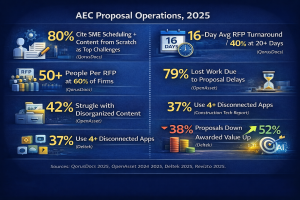
The QorusDocs 9th Annual Proposal Benchmark[1] Survey found that 80% of AEC respondents ranked SME scheduling and content creation from scratch as their top two challenges tied for the number-one position (QorusDocs, 2025).
AEC firms spend more time on RFP responses than any other industry surveyed. The average AEC team takes 16 days to complete a response, with 40% spending 20+ days compared to the cross-industry average of 9.3 days (QorusDocs, 2025). And the effort is massive: 60% of AEC firms reported 50+ people contributing to their RFP response process, versus just 18% across all industries.
The downstream cost is clear. OpenAsset’s 2024 State of Proposals report found that 79% of proposal teams say their firm has lost work due to proposal delays, and 42% of AEC marketers struggle with disorganized content and inconsistent branding (OpenAsset, 2024).
Technology fragmentation compounds the problem. The Construction Technology Report[2] found that 37% of firms use four or more disconnected applications per project, and 40% of workers spend a quarter or more of their workweek on repetitive tasks like email, data collection, and data entry (Revizto, 2025).
Yet the strategic shift is already underway. AEC firms are prioritizing quality over quantity. Proposal submissions fell 38% from 2024 to 2025, but the total dollar value of awarded work rose 52% (Deltek / OpenAsset, 2025). Firms integrating AI into business development and proposals saw median win rates climb to 50% in 2025 (OpenAsset, 2025[3]).
The firms winning aren’t submitting more. They’re submitting smarter with better visibility, faster assembly, and tighter alignment between pursuit strategy and team capacity.
Where the industry is heading
Three shifts are reshaping how AEC firms manage pursuits.
The first is consolidation from fragmented tools to unified work platforms. Firms that grew by adding a separate app for every function, one for scheduling, one for document storage, one for time tracking, one for bid status, are now paying the coordination tax. The move is toward single-platform environments where RFP tracking, resource planning, content libraries, and client deliverables connect in one workspace.
The second is AI moving from content generation to the pursuit of intelligence. More than half of A&E firms now use AI in business development, proposal writing, and project analytics, a sharp rise from 2024 (OpenAsset, 2025). The QorusDocs survey found 90% of AEC respondents use GenAI for researching and summarizing content, 80% for writing bios, and 70% for executive summaries (QorusDocs, 2025). The impact isn’t theoretical: firms integrating AI are winning at higher rates.
The third is the shift from reactive proposal assembly to proactive pursuit management. AEC firms are formalizing go/no-go processes, tracking pursuit metrics, and connecting business development data to project delivery, turning every bid into a strategic decision rather than a fire drill.
How monday.com fits AEC pursuit workflows
Monday.com is the only work management platform recognized as a Leader across three 2025 Gartner Magic Quadrant reports: Collaborative Work Management, Adaptive Project Management and Reporting, and Marketing Work Management (Gartner, 2025). Forrester’s Total Economic Impact study reports 346% ROI for Motorola, with a payback period under four months.
For AEC firms, monday.com’s Work OS maps directly to how pursuits flow from opportunity identification through post-submission debrief.
RFP intake and go/no-go tracking uses Forms to standardize how opportunities enter the system, capturing client, project type, procurement method, deadline, and evaluation criteria. Automated workflows route submissions through go/no-go scoring before any proposal effort begins.
Pursuit coordination connects everyone involved, principals, engineers, estimators, marketers, and subconsultants in a single workspace with Gantt views for timeline management, Kanban boards for content production stages, and Workload Views showing who has bandwidth across concurrent pursuits.
Client deliverable tracking extends beyond the proposal. Once work is won, the same platform manages project milestones, submittal schedules, and client communication so the transition from pursuit to delivery doesn’t require migrating data to a new system.
AI Blocks built into the platform handle operational tasks: Categorize tags incoming RFPs by project type and procurement method, Summarize, which condenses long solicitation documents into key requirements, and Extract info, which pulls deadlines, evaluation criteria, and scope details directly into board columns from uploaded RFP PDFs.
Monday.com integrates with 200+ tools, including Microsoft Teams, SharePoint, Google Drive, Outlook, Slack, and AutoCAD, and 90% of AEC organizations already store content in SharePoint (QorusDocs, 2025), making the integration immediate.
How Advaiya helps AEC firms implement monday.com
Advaiya works with organizations across construction, real estate, and infrastructure on project and work management implementations.
When Advaiya built a booking and operations platform for a sportline company, the result mirrors what AEC firms need from pursuit management: 90%+ reduction in manual work, over $1M in revenue tracked through the system, and streamlined operations across distributed teams (Advaiya Case Study Compendium).
Advaiya brings enterprise architecture expertise that connects how your BD, marketing, technical, and estimating teams actually work to how monday.com gets configured so the platform reflects real AEC pursuit workflows, not a generic project template.
Connect with Advaiya about monday.com for AEC →