
Airport digital transformation is the process of replacing fragmented legacy systems, siloed operational databases, disconnected ground handling tools, manual resource allocation, and aging infrastructure management with connected, cloud-based platforms that unify data across every airport stakeholder.
For airport CTOs, this isn’t about installing new screens at departure gates. It’s about rewiring the operational backbone: connecting the Airport Operational Database (AODB), flight scheduling, ground handler coordination, security systems, baggage handling, and facility management into a single data environment where decisions happen in real time.
The gap between what passengers see and what runs behind the scenes is where most airport digital transformation stalls.
The legacy problem: why most airport infrastructure is still decades behind
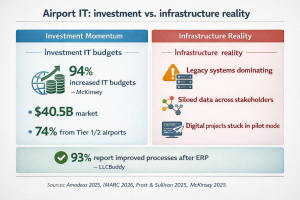
McKinsey’s interviews with 20+ senior airport executives across four regions found a consistent pattern: while traveler-facing technology looks modern, the infrastructure technology behind it is often outdated, hampered by legacy software, scattered data, and digital projects stuck in pilot mode (McKinsey, 2025).
Frost & Sullivan’s 2025 airport IT analysis confirmed that airport information technology is largely based on legacy systems, which hinders innovation and increases IT operations complexity (Frost & Sullivan, 2025). Cloud adoption remains slow, with airports gradually migrating workloads rather than executing comprehensive modernization.
Why fragmentation persists
Amadeus identified three structural barriers to airport digital transformation: legacy infrastructure that makes it difficult to integrate modern solutions without disrupting operations, data silos across airlines, ground services, and border control that prevent a cohesive digital ecosystem, and workforce gaps as staff need upskilling to operate increasingly complex digital systems (Amadeus, 2025).
The result: most airports operate as a collection of disconnected systems rather than a unified intelligent operation.
The investment is flowing but not always landing
The spending commitment is real. 94% of airport operators increased IT budgets for 2025, with digital customer experience and operational resilience as top priorities (Amadeus, 2025). The smart airport market was valued at $40.5 billion in 2025 and is projected to reach $83.9 billion by 2034 at an 8.44% CAGR (IMARC, 2026).
Tier 1 and Tier 2 airports account for approximately 74% of the global airport IT market, driven by high passenger traffic, complex IT ecosystems, and greater investment capacity (Frost & Sullivan, 2025).
But investment alone isn’t solving the problem. The shift in 2026 is from fragmented tools and local optimizations to connected, cloud-based platforms that function as the airport’s operating system, bringing together forecasting, real-time operations, resource management, and data integration into a single trusted source (Copenhagen Optimization, 2025).
Where the industry is heading
Cloud-native airport platforms replacing siloed tools
Gartner reports that cloud migration is the number two IT priority for CIOs in 2026, behind only cybersecurity (Gartner, 2026). By 2028, 75% of enterprise workloads will be in cloud or edge environments, up from 52% in 2024 (Gartner).
For airports, this means moving AODB systems, resource management, passenger flow analytics, and maintenance scheduling from on-premise servers to cloud-native architectures that scale with passenger volumes and share data across stakeholders in real time.
Organizations that modernize applications during migration see 40% higher ROI than lift-and-shift approaches (DataStackHub, 2025). For airports, that means rearchitecting how systems share data, not just moving old databases to new hosting.
AI-powered ground operations and predictive maintenance
McKinsey identified two high-impact use cases behind the scenes: AI algorithms that reallocate check-in counters, gates, and staff based on actual passenger flows in real time, and predictive maintenance systems using sensors on baggage belts, escalators, and HVAC to prevent unplanned downtime (McKinsey, 2025).
Shenzhen Airport’s AI-powered stand allocation reduced aircraft assignment time from four hours to one minute (Mordor Intelligence / Huawei, 2025). flydubai deployed an AI turnaround management program at DXB for full-scale digitization of aircraft turnaround workflows (APEX, 2026).
Cybersecurity as a transformation prerequisite
The aviation sector recorded a 74% jump in cyberattacks since 2020 (Mordor Intelligence, 2025). As airports connect more systems through IoT, cloud, and AI, security architecture must be embedded from the start, not bolted on after migration.
Gartner projects that 90% of organizations will adopt hybrid cloud by 2027 (Gartner). For airports, hybrid architectures that process sensitive data on-premise while running analytics and passenger services in the cloud offer the balance between security requirements and operational agility.
How Azure, Power BI, and cloud migration fit the modern airport stack
Azure: the cloud infrastructure layer
Azure provides the foundation for airport cloud migration from moving legacy AODB systems to Azure SQL and Azure App Service, to connecting IoT sensor networks through Azure IoT Hub, to running AI models at the edge through Azure IoT Edge for latency-sensitive operations like baggage sorting and security screening.
Azure Digital Twins creates virtual replicas of terminal operations, enabling airports to simulate what-if scenarios, testing the impact of a gate reassignment, a security lane closure, or a flight schedule change before it affects live operations.
Power BI: operational visibility across stakeholders
Power BI delivers real-time dashboards that unify data from AODB, flight schedules, ground handler systems, security queues, baggage handling, and facility sensors into one operational view.
Airport operations centers get live visibility into passenger flow, resource utilization, and equipment health. Airlines and ground handlers can access shared dashboards that reduce the coordination friction that siloed systems create.
Microsoft Fabric: unified data platform
Microsoft Fabric consolidates data engineering, real-time analytics, and BI into one platform. Forrester’s Total Economic Impact study found 379% ROI over three years with $779,000 in infrastructure savings from consolidating analytics tools (Forrester, 2026).
For airports running five or more disconnected data systems, Fabric eliminates the integration overhead that keeps operational data fragmented.
How Advaiya helps airports modernize operations
Advaiya works with organizations across airports, infrastructure, and energy on cloud migration and data analytics implementations within the Microsoft ecosystem.
When Advaiya deployed a document management system for an airport, replacing scattered manual processes with a Power Apps and SharePoint-based platform, the results demonstrated what infrastructure modernization delivers: 90%+ reduction in manual document handling, 95% compliance index, and 85% reduction in retrieval time (Advaiya Case Study Compendium).
Advaiya brings enterprise architecture expertise that connects airport operational requirements to Azure, Power BI, and Fabric configuration so the migration reflects how your operations, ground handling, security, and commercial teams actually work.
Connect with Advaiya about airport digital transformation →