
AI-driven passenger experience at airports is the convergence of real-time data analytics, predictive operations, and intelligent automation applied across every touchpoint of the traveler’s journey, from parking and check-in through security screening, wayfinding, retail, boarding, and baggage claim.
For airport CTOs, this isn’t a technology showcase. It’s an operational necessity.
Passenger volumes have recovered and surpassed pre-pandemic levels. Airports must handle more travelers without proportional physical expansion. AI turns existing infrastructure into adaptive systems that predict congestion, route passengers dynamically, trigger maintenance before equipment fails, and personalize services based on real-time context.
The operational reality: Rising volumes, aging infrastructure, and fragmented systems
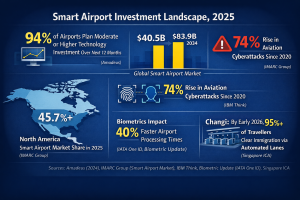
The investment momentum is real. Amadeus[1] reports that 94% of airport operators increased IT budgets for 2025, with digital customer experience and operational resilience as top priorities (Mordor Intelligence / Amadeus, 2025).
The smart airport[2] market was valued at $40.5 billion in 2025 and is projected to reach $83.9 billion by 2034 at an 8.44% CAGR (IMARC, 2026). North America dominates with over 45% market share, driven by smart infrastructure investments and AI adoption.
But most airports still run fragmented systems. Check-in, security, baggage handling, retail, parking, and flight operations often sit on disconnected platforms that can’t share data in real time. When a flight is delayed, the gate change doesn’t automatically update wayfinding signage, retail recommendations, or ground transport scheduling.
Cybersecurity adds urgency. The aviation sector recorded a 74% jump in cyberattacks since 2020 (Mordor Intelligence, 2025). As airports connect more systems through IoT and AI, the attack surface expands, making unified, secure data architectures more critical than ever.
Meanwhile, staffing constraints mirror every industry. Airports need to do more with fewer people. AI-powered self-service biometric check-in, automated bag drop, virtual concierges, and predictive queue management aren’t a convenience upgrade. It’s a capacity strategy.
Where the industry is heading
Three capabilities are defining the next generation of airport operations.
The first is predictive passenger flow management. AI models trained on historical traffic patterns, flight schedules, weather data, and real-time sensor feeds can forecast where congestion will form 30–60 minutes before it happens.
This allows airports to redeploy staff proactively, adjust security lane capacity, and reroute passengers through wayfinding systems before bottlenecks materialize. Shenzhen Airport’s AI-powered stand allocation system reduced aircraft assignment time from four hours to one minute, demonstrating how predictive intelligence compresses decision cycles (Mordor Intelligence / Huawei, 2025).
The second is biometric identity as the throughput backbone. Singapore Changi plans to automate 95% of immigration lanes by 2026. Dubai is deploying biometric boarding at Al Maktoum International. Europe’s Entry/Exit System, launching in 2025, requires biometric capture for all non-EU travelers (Mordor Intelligence, 2025).
Biometrics cut document checks by 40% while maintaining security standards. For airports, this isn’t a futuristic pilot; it’s becoming a regulatory mandate and operational baseline simultaneously.
The third is AI-powered predictive maintenance and asset management. Escalators, baggage carousels, HVAC systems, and jetbridges, when any of these fail during peak operations, the cascading delays compound across the terminal.
AI-driven sensors monitor equipment condition in real time and trigger maintenance work orders before failures occur. This is the same predictive maintenance model already proven in manufacturing, now applied to airport infrastructure, where uptime directly affects passenger experience.
How Azure, Power BI, and Dynamics 365 fit the smart airport stack
The Microsoft ecosystem provides the infrastructure layer that smart airport initiatives require from IoT data ingestion through operational analytics and field service management.
Azure IoT Hub connects the sensor networks that modern airports depend on, including passenger counters, baggage tracking RFID, environmental sensors, parking occupancy monitors, and equipment condition sensors. Azure Digital Twins creates virtual replicas of terminal operations, enabling airports to simulate passenger flow scenarios and test operational changes before deploying them.
Power BI delivers real-time operational dashboards that surface what matters: security queue wait times, gate utilization, baggage handling throughput, energy consumption, and retail performance, all in one view. When connected to Azure’s AI and analytics services, dashboards don’t just report current status. They predict where problems are forming and recommend interventions.
Dynamics 365 Field Service manages the maintenance and asset management layer. When an AI model detects that a baggage carousel motor is approaching failure thresholds, Dynamics 365 can automatically generate a work order, assign a technician based on skills and proximity, and track resolution using the same IoT-to-work-order automation that utility and manufacturing organizations rely on, applied to airport infrastructure.
Together, this stack connects the data that airports already generate into an intelligence layer that turns reactive operations into predictive, passenger-centric management.
How Advaiya helps airports build intelligent operations
Advaiya works with organizations across airports, infrastructure, and energy on business process automation and data analytics implementations within the Microsoft ecosystem.
When Advaiya deployed a document management system for an airport, the results demonstrated what intelligent airport operations deliver: 90%+ reduction in manual document handling, 95% compliance index, and 85% reduction in retrieval time built on Power Apps and SharePoint with custom navigation, structured folders, and enhanced security controls (Advaiya Case Study Compendium).
That same methodology, decomposing complex multi-stakeholder operations into automated, trackable processes, applies directly to passenger flow management, maintenance scheduling, and terminal operations.
Advaiya brings enterprise architecture expertise that connects airport operational requirements to Azure, Power BI, and Dynamics 365 configuration.
Connect with Advaiya about smart airport solutions →