Field service optimization in energy utilities is the discipline of dispatching the right technician with the right skills, parts, and route to the right location, whether that’s a planned transformer inspection, a smart meter installation, or an emergency outage restoration at 2 a.m. during a storm.
For utility CTOs, this goes beyond scheduling software. It’s about connecting work order generation, crew dispatch, inventory allocation, field communication, and billing into a single operational flow that scales during major weather events.
The challenge isn’t dispatching one crew to one site. It’s coordinating hundreds of crews, contractors, and mutual aid teams across thousands of active work orders while keeping customers informed with accurate restoration timelines.
The operational reality: Workforce gaps, weather events, and aging infrastructure
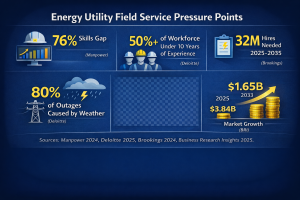
The workforce pressure is structural. 76% of energy and utility employers report a talent and skills gap within their existing workforce (Manpower, 2024).
Over half the current utility workforce has less than 10 years of experience, creating a skills deficit even as the industry saw[1] its fastest employment growth compared to traditional industrial sectors in the last two years (Deloitte, 2025 Power & Utilities Outlook).
Energy employers are forecast to hire 32 million people between 2025 and 2035, 17 million new workers and 15 million replacements (Brookings, 2024). That hiring demand makes field service efficiency existential, not optional.
Weather events compound the challenge. Between 2000 and 2023, 80% of all major power outages were caused by severe storms, wildfires, and extreme heat (Deloitte, 2025).
When a storm hits, utilities need to coordinate emergency crews, mutual aid teams from other states, tree crews, and outside contractors, often across systems that weren’t designed to talk to each other.
The infrastructure age adds a third layer. Aging grids require more preventive maintenance, inspections, and planned replacements, all competing for the same limited field workforce that also handles emergency response.
The global utility services market[2], valued at roughly $1.65 billion in 2024, is projected to reach $3.84 billion by 2033 at a 9.8% CAGR (Business Research Insights, 2025). But capturing that growth requires field operations that scale beyond disconnected legacy systems.
Where the industry is heading
Three shifts are reshaping how utilities manage field operations.
The first is the move from reactive outage response to predictive field operations. IoT sensors on grid assets, smart meters, and SCADA systems now generate continuous data streams that trigger work orders before equipment fails, not after customers call in.
Preventive maintenance based on actual asset condition rather than calendar schedules reduces emergency dispatches and extends equipment life.
The second is AI-powered scheduling, replacing manual dispatch. Resource scheduling optimization matches technician skills, certifications, territories, and availability to incoming work orders automatically.
During major events, hundreds of mutual aid crews can be assigned work without a dispatcher manually reviewing each one. IFS launched Resolve for Utilities at DISTRIBUTECH 2026, specifically for AI-driven crew callout (IFS, 2026), signaling that utility-specific AI scheduling is becoming a market baseline.
The third is the convergence of field service, asset management, and customer communication on unified platforms. Utilities running outage management, planned maintenance, and customer notifications on separate systems create information gaps that erode trust during storms.
The industry is moving toward single-platform environments where work orders, crew status, asset history, and ETA notifications flow from the same source.
How Dynamics 365 Field Service fits utility operations
Dynamics 365 Field Service combines workflow automation, scheduling algorithms, and mobility to manage the full field service lifecycle from work order generation through dispatch, execution, inventory tracking, and billing (Microsoft, 2025).
Four capabilities map directly to utility needs.
AI-powered scheduling uses the schedule board and Resource Scheduling Optimization to match work orders with technicians based on skills, certifications, territory, and proximity. Dispatchers can drag-and-drop, use the scheduling assistant, or run fully automated optimization across hundreds of concurrent work orders (Velosio / Microsoft, 2024).
During storm events, crews get assigned by location and qualification, not phone calls and spreadsheets.
IoT-triggered work orders connect grid sensors and smart meters directly to the platform. When a transformer shows abnormal temperature readings, the system automatically generates a work order, pre-populates it with asset history and required parts, and routes it for scheduling before a customer reports an issue (Microsoft / DynaTech, 2025).
Mobile workforce enablement gives technicians work order details, asset history, and step-by-step instructions on any device, including offline capability for rural areas with poor connectivity. Copilot in Field Service generates work order summaries and supports natural language queries against operational data (Microsoft, 2025).
Route optimization defines goals like “minimize total travel time” or “maximize total working hours,” and sequences stops automatically (Velosio, 2024). For utilities managing crews across large territories, this reduces fuel costs, increases jobs per day, and shortens response windows.
Conquest Completion Services achieved 80% improvement in operational efficiency, 7x faster invoicing, and 1,300 hours saved annually after implementing D365 Field Service (Rand Group, 2026).
Dynamics 365 integrates natively with Power BI, Microsoft Teams, Azure IoT, and Business Central.
How Advaiya helps utilities implement field service automation
Advaiya works with organizations across energy, infrastructure, and manufacturing on field service management implementations within the Microsoft ecosystem.
When Advaiya deployed a document management system for an airport, the results reflected what utilities need from field operations: 90%+ reduction in manual handling, 95% compliance index, and 85% reduction in retrieval time (Advaiya Case Study Compendium).
Advaiya also offers a field inspection app for Dynamics 365 Field Service, directly relevant to utility asset inspection and compliance workflows.
Advaiya brings enterprise architecture expertise that connects utility-specific requirements, outage response, crew dispatch rules, asset inspection schedules, and regulatory compliance to Dynamics 365 configuration.
Connect with Advaiya about field service for utilities →