Digital health transformation portfolio management is the discipline of prioritizing, sequencing, and resourcing every IT initiative a health system runs, from EHR optimization and FHIR-based interoperability builds to AI-assisted clinical workflows and patient engagement platforms against measurable care delivery outcomes rather than just technical milestones. It’s the layer where a CTO’s 30 or 40 concurrent projects stop being independent workstreams and start being a coordinated investment thesis tied to value-based care performance.
For health system CTOs and CXOs, the challenge isn’t launching digital initiatives. It’s knowing which combination of those initiatives moves the organization from HIMSS EMRAM Stage 4 to Stage 6, reduces readmission rates enough to protect shared savings margins, or builds the HL7 FHIR infrastructure that ABDM compliance and payer interoperability mandates demand, all within the same budget cycle and with the same constrained teams.
The spending-to-outcomes gap in healthcare IT
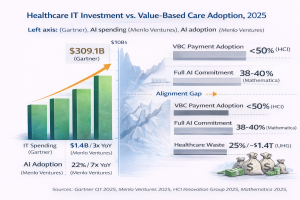
Healthcare organizations aren’t underinvesting in technology. Gartner forecasts global healthcare and life sciences IT spending will reach $309.1 billion in 2025, growing 8.7% year-over-year, with software spending rising 12.6% annually (Gartner, Q1 2025 Update). According to Menlo Ventures, healthcare AI spending hit $1.4 billion in 2025, nearly tripling the prior year’s investment, and health systems are deploying domain-specific AI tools at 2.2 times the rate of the broader economy, with 22% adoption representing a sevenfold increase over 2024 (Menlo Ventures, 2025 State of AI in Healthcare).
Yet the outcomes side hasn’t kept pace. Fewer than half of total healthcare payments were tied to value or risk-sharing models in 2025, roughly matching 2024 rates (HCI Innovation Group, 2025 Year in Review). A 2025 report from Mathematica and Reveleer found that while payers and providers align on value-based care goals, critical execution gaps are stalling progress only 40% of payers and 38% of providers describe their organizations as fully committed to AI adoption, citing system integration challenges, staff expertise gaps, and data governance concerns (Mathematica, 2025). And the broader waste problem persists: an estimated 25% of total U.S. healthcare spending, roughly $1.4 trillion of $5.6 trillion in 2025, goes to failures in care delivery, care coordination, overtreatment, and administrative complexity (UnitedHealth Group / Advancing Value-Based Care, 2025).
The disconnect isn’t a technology deficit. It’s a portfolio alignment problem. Health systems are running dozens of digital initiatives simultaneously FHIR API builds, ambient scribe deployments, revenue cycle automation, remote patient monitoring rollouts, cybersecurity remediation (with over 75% of organizations reporting disruptions in 2025 per HCI Innovation Group) and most lack the portfolio-level visibility to know which initiatives are actually advancing value-based care metrics versus consuming capacity on projects that don’t connect to reimbursement models, quality scores, or patient outcome benchmarks.
Where the industry is heading: Interoperability, AI-native workflows, and portfolio-level governance
Three converging forces are reshaping how health system IT portfolios need to be managed.
The first is interoperability mandates. FHIR R4 has become the baseline standard for health data exchange, with CMS interoperability rules requiring payers and providers to support standardized APIs. India’s ABDM (Ayushman Bharat Digital Mission) is creating a similar national health information exchange framework. Health systems need to sequence their HL7 FHIR integration work, patient portal builds, and data-sharing platform investments in a way that meets regulatory deadlines without overwhelming integration teams.
The second is AI moving from pilots to embedded workflows. Healthcare’s AI adoption surge from ambient clinical documentation to predictive analytics for population health means CIOs are now managing AI initiatives alongside traditional IT projects, each with different risk profiles, data governance requirements, and clinical validation timelines. Portfolio management needs to account for these fundamentally different project characteristics rather than treating an AI deployment the same way it treats an EHR module upgrade.
The third is digital maturity as a strategic benchmark. HIMSS EMRAM remains the global standard for measuring EMR adoption maturity across Stages 0 through 7, covering everything from clinical decision support to closed-loop medication administration and full data analytics integration. Achieving higher EMRAM stages requires coordinated execution across dozens of interdependent IT projects, patient portals, CPOE, pharmacy systems, clinical documentation, analytics platforms, and that coordination breaks down without portfolio-level visibility into dependencies, resource conflicts, and milestone sequencing. Forecasting models suggest the majority of U.S. hospitals won’t reach Stage 7 until 2035, absent major policy changes or capability leaps (JMIR/PMC, Forecasting EHR Maturation).
These three forces share a common requirement: the ability to manage IT investments not as isolated projects but as a coordinated portfolio where every initiative connects back to care delivery outcomes, regulatory compliance milestones, and financial performance targets.
How OnePlan connects IT capacity to care delivery outcomes
OnePlan is a strategic portfolio and work management platform built on Microsoft cloud, recognized as a “Strong Performer” in the Forrester Wave for Strategic Portfolio Management, Q2 2024, with the highest possible scores in integration and roadmap criteria. Microsoft has named OnePlan a Partner of the Year for project portfolio management five consecutive years. Enterprise clients include Johnson & Johnson, Kiewit, and Emory Healthcare, where the platform was deployed in 62 days.
For health system CIOs managing 30 or more concurrent IT initiatives, OnePlan’s value sits at three specific capability layers. Strategic alignment scoring lets leadership map every IT initiative whether it’s a FHIR integration build, an AI ambient scribe rollout, or a cybersecurity remediation program against weighted organizational objectives like EMRAM advancement, value-based care readiness, or regulatory compliance. Initiatives that don’t score against strategic objectives become visible candidates for deferral or cancellation, freeing capacity for work that moves the organization forward.
Resource and capacity planning surfaces constraints across clinical informatics, integration engineers, data architects, and project managers before those constraints create delivery delays. When the same FHIR integration team is needed for both a payer interoperability mandate and an ABDM compliance build, OnePlan shows the conflict at the portfolio level rather than letting it surface as a missed deadline three months later.
Scenario modeling lets operations leadership test portfolio-level trade-offs: what happens to EMRAM Stage 6 timelines if you accelerate the ambient documentation project? What’s the resource impact of adding a predictive readmission analytics initiative to the current portfolio? These aren’t questions individual project managers can answer; they require portfolio-level visibility across all active programs.
OnePlan integrates natively with Microsoft Teams, Power BI, Azure DevOps, and Project for the web, alongside Jira, Smartsheet, and monday.com. Its Sofia GPT capability uses Microsoft OpenAI for AI-assisted resource forecasting and scenario analysis.
How Advaiya helps health systems implement outcome-aligned portfolio management
Advaiya works with organizations across healthcare, manufacturing, and infrastructure on project and portfolio management implementations within the Microsoft ecosystem. When Advaiya deployed a unified CRM for a Fortune 500 company undergoing a complex merger, the results reflected the kind of large-scale data integration health systems face during digital transformation: 1 million+ records and 50,000+ documents migrated, 65% data redundancy reduction, and users trained across 60+ countries all requiring the same cross-functional coordination and phased execution that health IT portfolios demand.
For health systems evaluating OnePlan, Advaiya brings Microsoft ecosystem depth, enterprise architecture methodology, and implementation experience that connects strategic portfolio design to operational configuration so the platform reflects how your clinical informatics, IT operations, and value-based care teams actually plan and execute digital initiatives.
Connect with Advaiya about healthcare IT portfolio management →
FAQs