
Hospital capital project management is the discipline of planning, sequencing, and coordinating large-scale facility investments, bed tower expansions, ambulatory surgery center builds, OR suite renovations, HVAC system replacements, and biomedical equipment programs while keeping patient care running throughout construction. It’s not the management of a single build. It’s where health system leadership decides which investments get funded, how projects are phased across overlapping timelines, and whether a renovation, new build, or acquisition delivers the best return against a constrained capital budget.
For CTOs and CFOs in healthcare, this isn’t theoretical. Every capital allocation competes with clinical technology investments, workforce needs, and debt service obligations. Getting the sequencing wrong, breaking ground on a patient tower before resolving HVAC infrastructure in the existing plant, creates compounding cost overruns, infection control risk assessment (ICRA) complications, and compliance gaps that ripple through the system for years.
The financial reality is forcing a harder prioritization
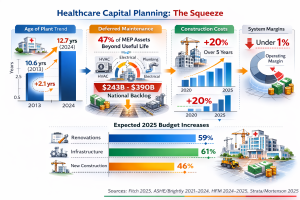
U.S. hospital infrastructure is aging faster than health systems can reinvest. The average age of plants for not-for-profit hospitals reached 12.7 years in FY24, the oldest in at least 13 years, climbing steadily from 10.6 years in 2013 (Fitch Ratings, 2025). The 2024 ASHE Hospital Operations Survey[1] found that 80% of executives cite aging facilities as their leading operational concern, with 58% naming funding constraints and staffing as their second biggest challenge (HFM / ASHE, 2024).
The deferred maintenance backlog is enormous. Facility condition assessment data shows approximately 47% of major mechanical, electrical, and plumbing assets across U.S. healthcare facilities have exceeded their expected useful life. National estimates to address the backlog range from $243 billion (Facility Health / Brightly, 2021) to over $390 billion (ASHE, 2024).
Construction costs have compounded the problem. Hospital project[2] costs per square foot rose more than 20% in five years (Health Facilities Management, 2024), while healthcare construction spending surged 35% from $48.4 billion in February 2021 to $65.3 billion in February 2023 (Federal Reserve Bank of St. Louis / HFMA). The all-in cost of construction capital reached approximately 6.87% in April 2024, more than seven times the January 2021 levels (HFMA / Juniper Advisory, 2024). Meanwhile, the national median health system margin fell to under 1% between 2024 and 2025 (Strata / Mortenson, 2025).
Despite all of this, capital spending is accelerating because it has to. The 2025 ASHE Hospital Construction Survey found that 59% of respondents expect renovation budget increases, 61% expect infrastructure upgrade increases, and 46% expect new construction growth from 2024 to 2025. Aging populations, longer inpatient stays, and competitive pressure from ambulatory entrants are forcing investment even as margins compress.
Where the industry is heading
The complexity of healthcare capital planning goes well beyond scheduling contractors. A typical health system manages a patient tower build, OR suite renovation, ambulatory center construction, HVAC replacement, and biomedical equipment cycle concurrently, each with different regulatory checkpoints (ICRA, interim life safety measures, NFPA compliance, NABH standards for accredited facilities), dependency chains, and patient care impact windows.
The 2025 ASHE survey highlighted Day 1 operational readiness as a persistent gap across the industry. Facilities finish construction but aren’t ready to admit patients because clinical engineering, IT infrastructure, commissioning, and regulatory certification run behind the construction timeline. That gap stems from poor cross-functional coordination at the portfolio level, not at the project level.
The Forrester Wave for Strategic Portfolio Management (Q2 2024) evaluated 12 providers across 22 criteria, reflecting the enterprise shift from isolated project tracking toward integrated strategy-to-execution platforms. For healthcare, this means moving into portfolio-level scenario modeling that connects facility condition assessments, bed capacity planning, capital forecasts, and regulatory milestones in a single view.
How OnePlan fits healthcare capital planning
OnePlan is a strategic portfolio and work management platform built on the Microsoft cloud. Forrester recognized OnePlan as a “Strong Performer” in the Q2 2024 Wave, with the highest possible scores in integration and roadmap criteria. Microsoft has named OnePlan a Partner of the Year for project portfolio management for five consecutive years. Enterprise clients include Johnson & Johnson, Kiewit Corporation, and Emory Healthcare, which deployed the platform in 62 days for portfolio reporting, project tracking, and time management.
Three capabilities map directly to healthcare’s capital planning challenges. Scenario modeling lets leadership compare allocation options: what’s the budget impact of phasing a patient tower into two stages? How does accelerating HVAC replacement in one building shift the OR renovation timeline in another? Resource and capacity planning surfaces constraints across project managers, clinical engineers, facilities teams, and IT before those constraints delay schedules. Financial planning tracks forecast versus actual spend by project, phase, and cost type, giving CFOs real-time visibility into capital burn against board-approved budgets.
OnePlan integrates natively with Microsoft Teams, Power BI, Azure DevOps, Project for the web, Jira, Smartsheet, and monday.com. Its Sofia GPT capability, built on Microsoft OpenAI, provides AI-assisted resource forecasting and scenario analysis. For health systems already invested in the Microsoft ecosystem, OnePlan extends that investment into capital portfolio management without requiring teams to change their day-to-day tools.
How Advaiya helps health systems implement portfolio management
Advaiya works with organizations across infrastructure, energy, and professional services on project and portfolio management implementations within the Microsoft ecosystem. When Advaiya deployed a document management system for an airport, the results demonstrated the same pattern healthcare capital planning demands: 90%+ reduction in manual document handling, 95% compliance index, and 85% reduction in document retrieval time through Power Apps and SharePoint workflows.
For health systems evaluating OnePlan, Advaiya brings enterprise architecture expertise, Microsoft integration depth, and implementation methodology that connects business process design to platform configuration so the tool maps to how facilities, finance, and clinical leadership actually make capital decisions.
Connect with Advaiya about healthcare capital portfolio management.