Construction isn’t like manufacturing or retail. A general contractor running twelve concurrent projects, each with its own subcontractor base, change order history, retainage schedule, and progress billing cadence, needs an ERP that understands project-based accounting at a structural level, not a generic financial system with a project module bolted on.
ERP in construction means tracking costs by job, phase, and cost code in real time. It means handling retainage holds, AIA G702/G703 pay applications, WIP schedules, and ASC 606 percentage-of-completion revenue recognition natively, not through spreadsheet workarounds that break the audit trail.
Most construction ERP implementations don’t fail because the software is bad. They fail because the software wasn’t built for how construction companies actually move money.
Why the industry’s financial workflows break generic systems
Slow payments cost U.S. construction $280 billion in 2024, roughly 14% of total industry expenditure (Rabbet). The cash flow mechanics are specific to construction: retainage withholds 5–10% from each pay application until substantial completion. Change orders shift scope and cost mid-project. AIA-format billing requires line-by-line documentation connecting completed work to scheduled values. And ASC 606 demands revenue match project progress, not invoicing.
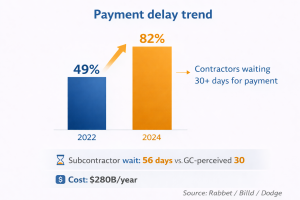
In 2024, 82% of contractors reported payment delays exceeding 30 days, up from 49% two years prior (Rabbet). Subcontractors waited 56 days on average while GCs believed they were paying in 30 (Billd, 2025). When the ERP can’t track retainage releases or surface WIP variances in real time, finance teams reconcile spreadsheets instead of managing cash.
Where the 70% fail: patterns from Gartner and the field
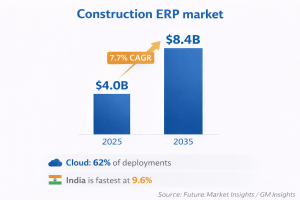
Gartner[1] predicts that by 2027, more than 70% of recently implemented ERP initiatives will fail to meet their original business goals up to 25% catastrophically. The construction ERP market, $4.0 billion in 2025 and projected at $8.4 billion by 2035 (Future Market Insights), is growing because so many first attempts went wrong.
The patterns are consistent. Generic ERP, construction-specific workflows: standard systems handle AP and GL but not retainage aging, lien waiver tracking, or progress billing tied to schedules of values. Configuration without discovery: when the partner configures standard financial practices instead of job costing by phase and cost code, subcontractor commitments, and change order cascades, the system fails on the jobsite.
Change management treated as training: Prosci research shows organizations with strong change management are six times more likely to meet project objectives and in construction, poor adoption by any one group undermines the entire deployment.
How the industry is moving: cloud ERP with real-time job costing
Cloud-based ERP now accounts for 62% of construction ERP deployments (GM Insights, 2024). When a PM approves a change order on-site, cloud ERP updates the job cost ledger, revises the WIP schedule, and adjusts the forecast simultaneously, a capability that legacy on-premises systems with overnight batch processing can’t close.
Forrester’s 2025[2] ERP Market Insights report notes that while most firms are increasing ERP budgets, tech executives must pressure-test AI promises before committing. For construction, that means choosing platforms where job costing, subcontractor management, and billing are native, not AI layered on a generic financial core.
What Business Central handles that generic ERPs don’t
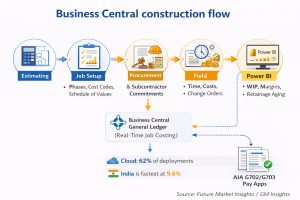
Dynamics 365 Business Central’s jobs module connects project management directly to the general ledger. Costs for labor, materials, equipment, and subcontractors track at the job level against the original estimate in real time. Change orders cascade to budgets immediately. Retainage and progress billing are native, reducing the reconciliation work that consumes finance teams on AIA-format projects.
Because Business Central sits in the Microsoft ecosystem, it connects to Power BI for WIP dashboards, Microsoft Project for scheduling, and Teams for field-to-office collaboration, directly addressing the adoption gap Gartner identifies as a primary failure driver.
Cloud architecture on Azure means automatic updates, predictable cost, and scalability as the portfolio grows without on-premises servers or upgrade cycles that trap firms in legacy versions.
How Advaiya helps construction firms get it right
Advaiya’s ERP practice brings construction-aware implementation discipline to Business Central. When Advaiya migrated a multi-entity real estate consulting firm from Tally to Business Central on the cloud, integrating CRM, HRMS, and custom billing across 15+ business units, the results: 80% improvement in billing accuracy and 60% reduction in approval dependency.
The same methodology applies to construction: requirements-first discovery before configuration, phased rollout starting with job costing and financials, and change management built into the timeline, not bolted on after go-live.
Talk to Advaiya about construction ERP →