
Construction ERP is the approach of connecting every function involved in delivering a project, from estimating and procurement through field execution and financial close, into a single platform backed by a shared database.
For construction CTOs, this means replacing the patchwork of disconnected tools that most firms run: estimating in one spreadsheet, procurement in another, accounting in a separate system, and project status tracked through email and phone calls.
The result of unified ERP is that a change order entered on a job site updates the budget, adjusts procurement commitments, and reflects in financial forecasts within the same system, without anyone re-entering the data.
The operational reality: why construction firms still run on disconnected systems
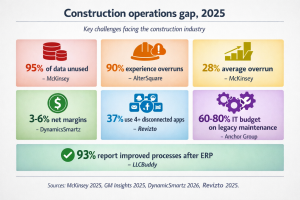
The scale of the problem is well documented. McKinsey reports that 95% of construction data goes unused, leading to miscommunication and delays that cause budget overruns averaging 28% (McKinsey / OpenAsset, 2025).
90% of construction projects experience overruns between 15% and 28% above initial estimates (AlterSquare / Anchor Group, 2026). In an industry where average net margins range between 3% and 6% (DynamicsSmartz, 2026), even small gaps in cost visibility erode profitability.
Why fragmented tools make the problem worse
37% of construction firms use four or more disconnected applications per project, and 40% of workers spend a quarter or more of their workweek on repetitive tasks like email, data collection, and data entry (Construction Technology Report / Revizto, 2025).
Organizations spend 60% to 80% of their IT budgets simply keeping legacy systems operational (Anchor Group, 2026). That leaves minimal room for the tools that would actually improve project outcomes.
Over 50% of engineering and construction professionals reported that one or more of their projects underperformed in the past year (Deloitte / LLCBuddy, 2025). When project tracking (cited by 73% of firms), job costing (72%), and estimating (66%) are the most sought-after capabilities in construction management systems, the demand for unified platforms is clear.
The market is responding
The construction ERP software market was valued at $3.7 billion in 2024 and is projected to grow at a 7.7% CAGR through 2034 (GM Insights, 2025). The broader construction software market reached $10.76 billion in 2025, projected to hit $24.72 billion by 2034 (DynamicsSmartz, 2026).
North America accounts for 42.5% of the global construction software market. The U.S. alone captured 86% of the construction ERP market in 2024 (GM Insights, 2025).
93% of companies that successfully deployed ERP report improved business processes (LLCBuddy, 2025). The question for most construction firms is no longer whether to adopt ERP, but whether their current system is actually built for how construction operates.
Where the industry is heading
Cloud ERP replacing on-premise installations
Cloud migration is the number two IT priority for CIOs in 2026, behind only cybersecurity (Gartner, 2026). Construction firms are shifting from on-premise servers to cloud-native platforms that provide real-time access from both office and field, automatic updates, and lower upfront infrastructure costs.
Organizations modernizing applications during migration see 40% higher ROI than lift-and-shift approaches (DataStackHub, 2025). For construction, this means rearchitecting how job costing, procurement, and project data flow between functions, not just hosting old software on new servers.
AI-powered cost control and schedule intelligence
AI is moving from experimental to operational in construction. AI-driven anomaly detection can flag cost overruns and schedule deviations as they emerge rather than after the monthly close. Predictive analytics models trained on historical project data help project managers forecast completion costs and identify risk patterns across the portfolio.
BIM integration connecting design to financial controls
Modern construction ERP platforms are integrating with Building Information Modeling (BIM) systems to connect 3D design models directly to cost estimates, procurement schedules, and change order workflows. This eliminates the disconnect between what gets designed and what gets built, tracked, and billed.
How Dynamics 365 fits the construction ERP stack
Gartner highlighted Microsoft’s integrated cloud stack, uniting Azure, Power BI, and Copilot Studio, as a defining strength in the 2025 Magic Quadrant for Cloud ERP for Product-Centric Enterprises (Gartner / CX Today, 2025).
For construction companies, two Dynamics 365 products provide the core ERP foundation.
Dynamics 365 Business Central: financial control for construction
Business Central delivers the accounting, procurement, inventory, and financial reporting backbone that construction firms need. Job costing by project, cost code, and phase connects field activity to financial outcomes in real time. Procurement workflows track purchase orders, vendor commitments, and material deliveries against project budgets. Multi-entity and multi-currency support handles firms operating across regions and business units.
Dynamics 365 Project Operations: project delivery and resource management
Project Operations connects project planning, resource scheduling, time and expense tracking, and billing into one workflow that runs from estimate through invoice. Resource managers see capacity across project managers, engineers, and field supervisors before making staffing commitments. Change order management updates schedules, costs, and revenue forecasts simultaneously rather than requiring manual reconciliation.
Power BI: real-time project intelligence
Power BI embeds operational dashboards directly inside the Dynamics 365 environment. Project health, budget vs. actuals, resource utilization, procurement status, and cash flow visibility surface where decisions happen, not in a separate reporting tool that project managers check once a week.
Dynamics 365 integrates natively with Microsoft Teams for project communication, SharePoint for document control, and Azure for IoT and field data when sensor-equipped equipment is part of the fleet.
How Advaiya helps construction firms implement unified ERP
Advaiya works with organizations across construction, real estate, and infrastructure on enterprise resource planning implementations within the Microsoft ecosystem.
When Advaiya deployed Dynamics 365 Business Central for a real estate consulting firm, the results reflected what construction companies need from unified ERP: 80% improvement in billing accuracy, 60% reduction in approval dependency, and integration with CRM and HRMS systems that previously operated in isolation (Advaiya Case Study Compendium).
Advaiya brings enterprise architecture expertise that connects construction-specific requirements, from job costing structures and subcontractor management to multi-site procurement and compliance tracking, to Dynamics 365 configuration.
Connect with Advaiya about construction ERP →