AI-Powered HSE safety & compliance on construction sites

AI-powered HSE management in construction is the shift from periodic manual inspections and paper-based incident reports to continuous, data-driven monitoring that detects hazards in real time, predicts where incidents are most likely to occur, and automates the compliance documentation that regulators require.

For construction CTOs, this means replacing the clipboard-and-walkthrough model that can’t keep pace with multi-site complexity. When a safety manager oversees three active job sites with dozens of subcontractors, the gap between inspections is where incidents happen. AI closes that gap by providing continuous visibility into PPE compliance, restricted zone access, equipment condition, and worker behavior patterns across every site simultaneously.

The question is no longer whether AI improves construction safety. Companies using AI-powered systems report incident reductions of 40% to 60% (ABC Carolinas / SocialMed.AI, 2025-2026). The question is how fast your HSE operations can adopt it.

The safety gap: why traditional approaches aren’t scaling

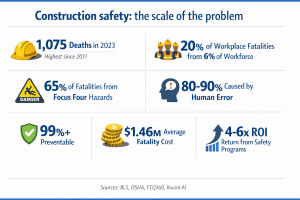
Construction remains the deadliest private sector industry in the United States. In 2023, 1,075 construction workers died on the job, the highest number since 2011 (BLS / ISHN, 2025). Construction accounts for approximately 20% of all workplace fatalities despite representing only 6% of the workforce (BLS / Workyard, 2025).

The “Focus Four” hazards (falls, struck-by incidents, electrocutions, and caught-in/between accidents) are responsible for 65% of construction fatalities (BLS / OSHA Practice, 2025). Falls alone account for 38.4% of construction deaths (BLS / Procore, 2022). Fall protection remains the most frequently cited OSHA violation year after year.

Why manual safety systems fail at scale

80% to 90% of serious construction injuries are caused by human error (OSHA Outreach Courses, 2025). Over 99% of construction accidents are preventable, yet the manual inspection model can’t provide the continuous monitoring needed to catch errors before they become incidents.

Small businesses with 1 to 10 workers account for 57% of fatal injuries, with more than 70% of deadly falls occurring in these settings (OSHA Practice, 2025). The firms with the fewest safety resources face the greatest risk.

Safety programs deliver 4x to 6x ROI, while construction fatalities average $1.46 million each and serious injuries average $43,000 (FTQ360, 2025). The cost of the top five injury causes in construction is roughly $7.87 billion in workers’ compensation alone (Kwant AI, 2024). The economic case for proactive safety technology is clear.


unnamed (1)

Where the industry is heading

Computer vision for continuous site monitoring

AI-powered cameras now detect missing PPE, workers entering restricted zones, and proximity hazards with detection accuracy exceeding 95% for common violations (SocialMed.AI, 2025). Unlike periodic inspections, these systems provide 24/7 monitoring across every camera-equipped area of the site.

The practical value extends beyond real-time alerts. Computer vision creates trend visibility: which crews, tasks, times of day, or subcontractors drive repeated safety exposures. That pattern data is what enables targeted interventions before incidents occur.

Predictive analytics identifies high-risk conditions

Predictive analytics models trained on historical incidents, near-misses, weather data, production schedules, and crew information estimate where and when future incidents are most likely (ABC Carolinas, 2025). A model might identify that struck-by incidents increase during afternoon shifts when specific subcontractors move materials in high-wind conditions, prompting extra supervision before work begins.

28% of EHS functions already use AI, while nearly half plan to invest in AI-enabled capabilities within the next year (Verdantix / Protex AI, 2025). 53% of firms plan to increase AI budgets by at least 10% in 2025, citing cost savings and risk reduction as primary drivers (Verdantix, 2024).

Wearables and IoT for worker-level safety

Smart helmets, vests, and wristbands now track worker location, detect falls, monitor fatigue through physiological signals, and alert supervisors when someone enters a hazardous zone. A 2025 systematic review confirmed the growing feasibility of using wearables combined with AI to classify fatigue states from ECG, EMG, and other biomarkers (Vanguard EHS, 2026).

Automated compliance documentation

OSHA’s 2025 requirements expanded electronic submission obligations for companies with 100+ employees and introduced stricter enforcement under the Severe Violator Enforcement Program (Spot AI, 2025). AI systems automatically document safety observations, violations, and corrective actions, reducing administrative burden while ensuring audit-ready records.

How Power Platform and Azure fit the construction HSE stack

Advaiya’s Project HSE Score Tracker

Advaiya built the Project HSE Score Tracker as a Power Platform accelerator specifically designed for construction HSE operations. The tracker provides a centralized scoring system that quantifies safety performance across projects, sites, and subcontractors, turning qualitative safety assessments into measurable, comparable data.

The HSE Score Tracker connects safety observations, incident reports, compliance checklists, and corrective actions into a single dashboard where project managers and safety directors see real-time safety health across the entire portfolio. When a site’s HSE score drops below the threshold, the system triggers automated escalation workflows that route to the right decision-maker without waiting for the next scheduled review.

Power Platform: automated workflows and mobile field capture

Power Apps provides mobile inspection forms that safety managers complete on-site, with photo documentation, GPS tagging, and automated routing to project leads. Power Automate triggers corrective action workflows when violations are logged, assigns follow-up tasks with deadlines, and escalates unresolved items. Power BI embeds safety dashboards inside the project management environment, so HSE data surfaces where operational decisions happen.

Azure AI: the intelligence layer

Azure Machine Learning trains predictive models on historical incident data, site conditions, and workforce patterns to identify high-risk scenarios before they produce injuries. Azure IoT Hub connects wearable devices and environmental sensors to the central safety platform, providing the continuous data stream that AI models need to move from reactive to predictive.

For construction firms running Dynamics 365 Project Operations, the integration means safety data flows alongside project cost, schedule, and resource information, giving leadership a complete view of both project delivery and worker protection.

How Advaiya helps construction firms modernize HSE operations

Advaiya works with organizations across construction, infrastructure, and energy on business process automation and HSE technology implementations within the Microsoft ecosystem.

When Advaiya deployed a document management system for an airport, the operational challenges mirrored what construction firms face with multi-site HSE compliance: scattered safety documentation, manual compliance tracking across departments, and the need for centralized audit-ready records. The results demonstrated what structured digital workflows deliver: 90%+ reduction in manual document handling, 95% compliance index, and 85% reduction in retrieval time (Advaiya Case Study Compendium).

Advaiya’s HSE Score Tracker accelerator gives construction firms a ready-to-deploy safety management platform that connects to the broader Microsoft ecosystem, so HSE data integrates with project management, financial controls, and executive reporting without custom development.

Connect with Advaiya about construction HSE technology →

FAQs

AI provides continuous monitoring that catches hazards between inspections. Companies report 40-60% incident reductions through real-time PPE detection, restricted zone monitoring, and predictive risk analytics.

It's a Power Platform accelerator that quantifies safety performance across projects and subcontractors, providing real-time dashboards with automated escalation when scores drop below thresholds.

Yes. Power Platform integrates natively with Dynamics 365, SharePoint, and Teams. Azure IoT connects wearables and sensors to the central safety platform without replacing existing project management systems.

Safety programs deliver 4-6x ROI. With fatalities averaging $1.46M and serious injuries $43,000, even preventing a small number of incidents generates significant returns beyond compliance.

Authored by

Kamal Kant Paliwal

Kamal is a Principal at Advaiya, where he has worked with clients in an array of industries in areas such as complex systems delivery, infrastructure services, security, architecture, and IT strategy. Earlier in his career at Advaiya, he has played key roles as Technical Consultant, Architect, Business Analyst, Project Manager, and Developer. Over these years, Kamal has gained experience working on Microsoft and other ALM tools and technologies to visualize, develop, and implement solutions. Kamal has a wealth of experience in developing innovative and robust technology solutions in response to business objectives. Integral to his success, is his ability to think beyond conventional solutions for a compelling, market-relevant output for the client. He has received his Master’s Degree in Computer Application from Sikkim Manipal University of Health, Medical, and Technological Sciences.

Categories

Contact Us

Similar blogs

Blog

Blog

Ready to revolutionize your business?