
A digital twin is a continuously updated virtual model of a physical asset, a wind turbine, a solar inverter, or a substation that mirrors real-time operating conditions and simulates future behavior. In renewable energy, the twin ingests telemetry from SCADA systems, vibration sensors, temperature probes, and weather feeds. Connected to physics-based and ML models, it forecasts when a gearbox bearing will degrade past threshold, when inverter conversion efficiency will drop below clipping point, and when soiling will make cleaning more economical than waiting.
The shift is from calendar-based maintenance to condition-based prediction that dispatches technicians only when the data says it’s time.
The cost problem: O&M is where renewable economics quietly erode
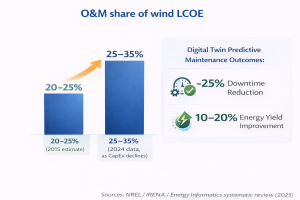
Onshore wind LCOE reached $0.034/kWh in 2024, and solar PV hit $0.043/kWh 91% of newly commissioned capacity was cheaper than the cheapest fossil fuel alternative (IRENA, July 2025). But those figures mask a structural vulnerability: O&M accounts for 20% to over 35% of lifetime LCOE, and that share grows as CapEx declines faster than OpEx (NREL / Wiser et al.).
For a 200 MW onshore wind farm, that’s $8–12 million annually. Unscheduled maintenance, a gearbox replacement requiring a heavy-lift crane, and a turbine inaccessible during winter weather are the most volatile components. Every hour of unplanned downtime reduces capacity factor, the metric determining whether a project meets PPA obligations or faces penalties.
The sector added a record 582 GW in 2024 (IRENA, 2025). As fleets scale, operators who compress O&M cost per MWh gain a compounding advantage.
Where the industry is heading: From monitoring to autonomous asset management
Gartner ranked digital twins among the top 10 strategic technology trends for three consecutive years (IET Smart Grid / Al-Shetwi, 2025). The global digital twin market reached $13.6 billion in 2024 and is projected to grow at 41.4% CAGR through 2034, with energy as a primary adoption sector (Grand View Research, 2025). Digital twins for sustainable energy specifically are projected to reduce operational costs by up to 30% (IntelMarketResearch, 2025).
Real-world deployments confirm the economics. A systematic review of 150 peer-reviewed publications covering digital twin applications in renewable energy found that GE’s Digital Wind Farm demonstrated up to 25% reduction in downtime and 10–20% improvements in energy yield through predictive maintenance (Energy Informatics, Devi et al., 2025). South Korea’s Doosan Heavy Industries built Azure-powered digital twins for 16 wind farms, enabling remote fault diagnosis and predictive maintenance that eliminated unnecessary physical inspections (Microsoft / Bentley Systems). Bentley Systems reported 15% O&M cost reduction at facilities using their Azure-integrated digital twin platform (Microsoft Azure Blog, 2023).
The pattern across all three deployments: move from threshold-based SCADA alarms to model-driven prediction, and you catch failures weeks earlier, dispatch with the right parts on the first visit, and protect the capacity factor.
[CHART PLACEHOLDER Digital twin market trajectory: $13.6B (2024) → 41.4% CAGR to 2034. Sector adoption: manufacturing, energy, automotive. Proven renewable energy results: 25% downtime reduction (GE), 10–20% yield improvement (systematic review), 15% O&M cost cut (Bentley/Azure), up to 30% operational savings (market projection). Sources: Grand View Research / Energy Informatics / IntelMarketResearch / Microsoft Azure Blog]
The technology stack: Azure Digital Twins + Databricks + Power BI
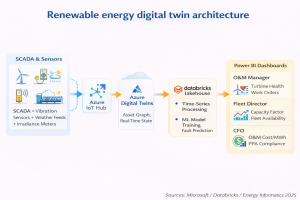
Azure Digital Twins provides the structural model, a graph-based representation of every turbine, inverter, gearbox, and substation, their relationships, and their real-time state. Telemetry from existing SCADA systems flows through Azure IoT Hub without replacing the operational technology infrastructure already in place. The twin updates continuously as sensor readings arrive.
Databricks adds the analytics and ML layer. Renewable assets generate millions of time-series data points, including daily vibration spectra, temperature gradients, power curves, and weather correlations. Databricks processes this at scale, trains fault-detection models specific to each asset class, and delivers predictions back to operations. Databricks offers a wind turbine predictive maintenance accelerator that combines domain-specific physics models with ML to analyze farm-wide productivity and flag degrading turbines before failure (Databricks, 2024). Shell, Octopus Energy, and SSE Energy Solutions are among the operators building on this platform.
Power BI surfaces the intelligence for different roles. Site O&M managers see turbine-level health scores and predicted failure timelines. Fleet directors see capacity factor trends across the portfolio. CFOs see O&M cost per MWh trending against PPA commitments.
How Advaiya builds renewable energy asset intelligence
Advaiya works with energy, utilities, and infrastructure clients across the Microsoft Azure ecosystem. When Advaiya built a unified data platform for a manufacturing and infrastructure conglomerate, the results reflected the same pattern digital twins require: 20% energy efficiency improvement, 10,000+ tons of CO2 emissions reduced, and 300+ automated validation workflows replacing manual reconciliation.
The approach starts with connecting existing SCADA and sensor infrastructure to Azure IoT Hub, building the asset ontology in Azure Digital Twins, configuring the Databricks lakehouse for time-series ingestion and ML training, and delivering role-specific Power BI dashboards that turn predictions into maintenance decisions. No control system replacement required.
Connect with Advaiya about renewable energy digital twins →