Advanced Driver-Assistance Systems (ADAS) automatic emergency braking, lane-keeping assist, adaptive cruise control, and parking automation, depend on arrays of cameras, radar, ultrasonic sensors, and LiDAR modules that must be physically mounted, electrically connected, and calibrated with sub-millimeter precision before the vehicle leaves the line.
That precision requirement has fundamentally changed what automation in automobile manufacturing means. It’s no longer about speed alone. It’s about tolerances that human operators can’t consistently hit at production scale, validated through software routines that didn’t exist five years ago.
Why the manufacturing model is under pressure
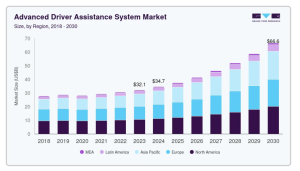
The global ADAS market[1] was valued at $34.65 billion in 2024 and is projected to reach $66.56 billion by 2030, growing at a 12.2% CAGR (Grand View Research). Regulatory mandates in the EU and the US are converting previously optional safety features into baseline requirements. For OEMs, ADAS integration is no longer a niche competency; it’s a production prerequisite.
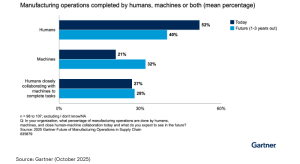
At the same time, Gartner reports[2] that two-thirds of US manufacturing organizations are not pursuing the aggressive redesign needed to deliver on advanced automation expectations, including AI and autonomous robotics (Gartner, survey). And nearly half lack confidence in their manufacturing strategy to deliver business outcomes over the next three years.
The disconnect is stark: ADAS complexity is rising while most factories aren’t keeping pace. Every manually installed and calibrated sensor is a quality risk. A front camera miscalibrated by a fraction of a degree can cause a lane-departure system to misfire, and every catch at the end-of-line is a rework event with cost and schedule implications.
How automation is closing the gap
AI-powered quality control. Traditional visual inspection can’t match the tolerances ADAS assembly demands. Manufacturers are deploying machine vision systems that analyze sensor and component data in real time, catching anomalies invisible to the human eye. Industry data shows that automated vision systems can reduce scrap by 30–35% (SEDIN Engineering), and BMW has reported efficiency gains of over 20% by automating tasks like welding and painting with AI-powered robotics.
Collaborative robots (cobots). Cobots designed to work alongside human operators are taking on precision-critical ADAS tasks: placing sensors into mounting brackets, tightening fasteners to specified torque, and routing wiring harnesses. Cobots are projected to represent over 35% of automotive robot installations by 2025 (Sora Robotic), and automotive OEMs led North American robot orders with a 34% year-over-year increase in H1 2025 (Association for Advancing Automation).
Digital twins for process validation. Before reconfiguring a line for a new ADAS variant, manufacturers are using digital twins to simulate robot reach envelopes, predict cycle times, and flag interference points, reducing the cost and time of physical trials. Gartner predicts that by 2030, at least one automaker will achieve fully automated vehicle assembly, with 12 of the top 25 already piloting advanced robotics (Gartner, December 2025[3]).
LiDAR calibration and PPAP compliance. Automated calibration stations embedded in the assembly line use robotic arms and reference targets to validate sensor alignment, a process that feeds directly into Production Part Approval Process (PPAP) documentation and Statistical Process Control (SPC) charts, closing the loop between quality and compliance.
The data infrastructure behind smart manufacturing
None of these capabilities work without a data layer connecting what have historically been siloed systems: MES, ERP, quality management, and sensor telemetry. ADAS production lines generate massive volumes of calibration logs, robot diagnostics, and inspection records. Making that data actionable requires integration.
Azure IoT Hub and Azure Stream Analytics allow manufacturers to ingest real-time sensor data from the line. Microsoft Fabric unifies production data across operational and analytical workloads, connecting shop-floor telemetry to executive dashboards without building separate pipelines. Power Platform enables operations teams to build custom quality tracking apps and automated alert workflows without waiting on IT backlogs.
The AI in manufacturing market reflects the urgency: valued at $34.18 billion in 2025, it’s projected to reach $155 billion by 2030 at a 35.3% CAGR (Research and Markets, 2025[4]). The investment isn’t speculative; it’s the infrastructure that makes ADAS-grade production quality repeatable.
Advaiya’s data and analytics services help manufacturers build the pipelines and dashboards that turn raw production data into operational insight, from connecting Azure Data Factory to legacy MES systems to building Power BI dashboards for real-time OEE tracking.
How Advaiya helps manufacturers make this transition
When Advaiya worked with a Fortune 500 industrial manufacturer to unify disparate systems, the team migrated 1M+ records and reduced data redundancy by 65%, the same integration challenge automotive manufacturers face connecting new automated equipment to existing ERP and quality platforms.
Advaiya’s digital transformation practice supports automotive and industrial manufacturers from roadmap through implementation, AI strategy consulting, ERP, and MES integration on Dynamics 365, and adoption frameworks that make automation investments deliver.
Talk to Advaiya about your manufacturing digital transformation.