Managing multiple projects across an enterprise without centralized visibility creates bottlenecks, resource conflicts, and misaligned priorities. Microsoft PPM (Project Portfolio Management) addresses these challenges by providing a unified platform that connects project execution with strategic business objectives.
As organizations scale operations, portfolio-level oversight becomes critical to ensure resources are optimized and initiatives deliver measurable value. The question isn’t whether to implement portfolio management, it’s how quickly you can deploy the capabilities that separate high-performing organizations from their competitors.
Why portfolio management matters for enterprise strategy
Strategic alignment drives competitive advantage
Portfolio management bridges the gap between strategy and execution. Without centralized oversight, organizations fund projects based on political influence rather than strategic value. Teams work on initiatives that made sense when approved, but no longer align with current market conditions or business priorities.
Microsoft PPM provides executives with a single source of truth for all portfolio data. Leaders can quickly assess which initiatives align with strategic priorities, reallocate resources to high-value projects, and sunset initiatives that no longer serve business objectives.
Resource optimization becomes measurable
Organizations face persistent talent shortages and budget constraints. Traditional project management approaches lack visibility into capacity across the enterprise, leading to over-allocation in some areas and under-utilization in others.
Portfolio management transforms resource allocation from reactive assignment to strategic capacity planning. Microsoft PPM can increase resource utilization by approximately 20%[1], helping organizations maximize return on talent investments. This isn’t about working people harder; it’s about eliminating the gaps and conflicts that waste available capacity.
Data-driven decisions replace intuition
Executives make investment decisions with incomplete information when project data lives in disparate systems. Portfolio management consolidates project performance, resource allocation, financial data, and strategic alignment metrics in a centralized platform.
This enables analytics that would be impossible with disconnected tools. Portfolio managers can identify patterns, compare performance across projects, and use historical data to improve estimation accuracy. Decisions move from subjective assessments to evidence-based evaluations.
Risk visibility enables proactive intervention
The project portfolio management market grew 11.5% to $7.46 billion in 2024[2], reflecting increased enterprise adoption of centralized portfolio management solutions. This growth stems from organizations recognizing that reactive risk management no longer suffices in fast-moving markets.
Portfolio-level risk visibility allows executives to identify dependencies, resource constraints, and strategic misalignment before they impact delivery. Project managers can proactively address issues before they escalate, improving overall portfolio success rates.
Core capabilities that drive project portfolio management
Microsoft PPM consists of several integrated tools that work together to support enterprise project management. The platform architecture is built on Microsoft 365, integrating seamlessly with Teams for collaboration, SharePoint for document management, and other productivity tools.
Strategic portfolio planning and prioritization
Portfolio managers gain a comprehensive view of all projects across the organization. You can prioritize initiatives based on strategic alignment, compare projects using custom scoring models, and make decisions based on resource availability and business value.
The platform enables:
- Standardized project intake processes that capture requests from across the enterprise
- Scoring models that evaluate projects against strategic criteria
- Scenario modeling to assess portfolio composition under different constraints
- Investment mix analysis to ensure balanced risk and return
This moves beyond ad-hoc project approval to systematic portfolio optimization aligned with business strategy.
Enterprise resource management and capacity planning
The resource management module provides visibility into capacity, utilization, and availability across the enterprise. You can identify resource conflicts before they impact delivery, balance workloads across teams, and forecast future capacity needs.
Key capabilities include:
- Skills inventory management to match resources with project requirements
- Capacity planning that forecasts resource needs 6-12 months ahead
- Utilization tracking that identifies over-allocation and under-utilization
- Resource request workflows that streamline allocation decisions
Organizations implementing project portfolio management with AI-driven resource optimization report significant improvements in utilization rates and reduced scheduling conflicts.
Detailed project planning and execution
Project managers can create detailed schedules with task dependencies, critical path analysis, and Gantt chart visualization. The platform allows you to define milestones, set baseline schedules, and track variances between planned and actual progress.
Integration with workflow automation capabilities eliminates manual coordination overhead. Tasks route intelligently, approvals trigger automatically, and project status updates across systems without manual intervention.
Executive dashboards and portfolio analytics
Built-in dashboards and custom reports give executives real-time visibility into portfolio performance. Integration with Power BI enables advanced analytics, trend analysis, and predictive insights.
Reports track:
- Budget variance across the portfolio
- Schedule adherence and on-time delivery rates
- Resource utilization and capacity constraints
- Strategic alignment and value realization
- Risk exposure and mitigation effectiveness
This transforms portfolio management from periodic reviews to continuous oversight that enables rapid decision-making.
Business value and measurable outcomes
Improved project delivery rates
Organizations that implement portfolio management experience measurable improvements in project outcomes. With better visibility into dependencies, resource constraints, and risks, project managers can proactively address issues before they escalate.
Centralized portfolio management helps organizations standardize processes and templates, ensuring consistency in project delivery across the enterprise. This systematic approach drives higher success rates than ad-hoc project management.
Enhanced cross-functional collaboration
Integration with Microsoft Teams and SharePoint enables seamless collaboration between project teams, stakeholders, and executives. Team members can access project information, submit timesheets, and update task status without leaving their familiar Microsoft 365 environment.
This reduces the friction that often accompanies portfolio management tools requiring separate login credentials and unfamiliar interfaces.
Strategic investment optimization
Portfolio management enables executives to make informed investment decisions based on data rather than intuition. When individual project budgets are exceeded, portfolio visibility helps leaders assess potential impacts to other projects and determine whether continuing an over-budget project will create multiplied financial overages elsewhere.
When projects fall behind schedule, leadership can evaluate ripple effects across dependent initiatives and reallocate resources to protect strategic commitments.
Scalability for growing organizations
Over 1,210 companies worldwide use Microsoft Project Portfolio Management, with the majority located in the United States. The platform is most commonly adopted by large enterprises with 10,000 or more employees, though mid-sized organizations increasingly adopt PPM solutions.
The small and medium enterprise segment is expected to register the highest CAGR of 15.2% from 2025 to 2030[3], indicating growing adoption beyond large enterprises. This reflects market recognition that portfolio management delivers value at any scale.
 Credit: Mordorintelligence
Strategic considerations for 2026
Project Online retirement requires migration planning
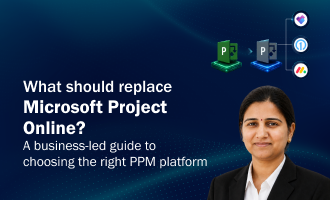
Microsoft announced that Project Online will be retired on September 30, 2026. Organizations currently using Project Online need to plan migration strategies to alternative solutions. The retirement stems from legacy architecture limitations and a lack of modern cloud capabilities, including AI and Copilot integration.
If your organization relies on Project Online, start evaluating migration options now. Microsoft offers migration paths to Project for the Web and third-party PPM solutions, but transitions require careful planning to ensure continuity of operations and data integrity.
This represents both a challenge and an opportunity. Organizations forced to migrate can reassess their portfolio management requirements and select solutions that better align with current needs and future strategy.
AI integration transforms portfolio intelligence
The convergence of portfolio management and AI capabilities is redefining what’s possible in project delivery. Predictive analytics identify risks before they materialize, resource optimization algorithms balance workloads dynamically, and natural language interfaces simplify portfolio analysis.
Organizations implementing portfolio management in 2026 should prioritize platforms with robust AI capabilities that will continue evolving as the technology matures.
Cloud-native architecture enables continuous innovation
Legacy on-premises portfolio management systems require significant IT resources to maintain and upgrade. Cloud migration eliminates this overhead while enabling access to continuous platform improvements.
Modern portfolio management platforms deliver new capabilities quarterly rather than requiring major upgrade projects every few years. This ensures organizations benefit from the latest innovations without disruption.
Transform portfolio performance
Microsoft PPM provides the foundation for strategic portfolio management that connects project execution with business objectives. As organizations face increasing pressure to do more with less, centralized portfolio management becomes essential for competitive advantage.
As a Microsoft Solutions Partner specializing in enterprise solutions, Advaiya helps organizations design and implement portfolio management strategies aligned with business objectives. Our expertise spans Power Platform development, Dynamics 365 implementation, and enterprise architecture to ensure portfolio capabilities integrate seamlessly with existing systems.
Whether you need to migrate from Project Online, implement portfolio management for the first time, or optimize existing capabilities, we provide strategic guidance and technical implementation expertise grounded in proven methodologies.
Contact us to discuss how portfolio management can transform your project delivery, or schedule a consultation with our portfolio management specialists.