Manufacturers do not lack data. A typical multi-plant operator has SCADA tags streaming every second, a historian holding decades of process data, an MES tracking work orders, a quality system holding lab results, a CMMS recording maintenance, an ERP closing the books, and a handful of spreadsheets someone in the corner office trusts more than any of it. The problem is not data scarcity. The problem is that each system was bought for a different reason, sits behind a different protocol, and answers to a different owner.
That fragmentation is why most manufacturing dashboards arrive too late, too aggregated, and too disconnected from the line. Operations leaders see yesterday’s OEE in a Monday meeting. Plant engineers run root-cause analysis by pulling exports from four systems into Excel. Corporate finance asks a question on Tuesday that takes three plants and IT until Friday to answer. The cost shows up not in software licenses but in decisions that arrive after the window to act on them has closed.
Why manufacturing data stays trapped in plant silos
Manufacturing data stays trapped because the operational technology stack and the information technology stack were built to ignore each other. The OT side, including PLCs, SCADA, historians, and MES, is engineered for deterministic control of physical processes. The IT side, including ERP, data warehouses, and BI tools, is engineered for transactional and analytical workloads. The two use different protocols, different time scales, different data models, and historically different teams.
The result repeats in every multi-plant operator:
- Each plant has its own historian, MES configuration, and tag naming convention.
- Cross-plant benchmarking is manual because no shared schema exists.
- IT data lakes built for ERP data choke on high-frequency tag data from the floor.
- Sensor data sits in plant-level databases that corporate analytics never touches.
- Real-time decisions stay on the floor; analytical decisions stay at headquarters; neither informs the other.
Past attempts to fix this with bespoke industrial data lakes have a poor track record. The structural problem was never a tooling gap; ingestion, modeling, real-time analytics, and BI sat on four different platforms that had to be integrated by someone.
What Microsoft Fabric provides for manufacturing data integration
Microsoft Fabric is a unified SaaS analytics platform that consolidates data ingestion, storage, real-time intelligence, data engineering, data science, and Power BI into one workspace built on a single data lake called OneLake. For manufacturers, that consolidation matters because the previous integration problem becomes a configuration problem. Four capabilities do the heavy lifting on the plant floor.
OneLake as the single store for OT and IT data
OneLake holds structured tables from ERP and MES, semi-structured event streams from sensors and PLCs, and unstructured files like maintenance manuals and FMEA documents in one logical lake. Shortcuts let teams reference data in Azure Data Lake, Amazon S3, or existing historians without copying it. The plant historian does not have to be ripped out; its data becomes addressable from the same lake that holds the corporate warehouse.
Real-Time Intelligence for streaming shop floor data
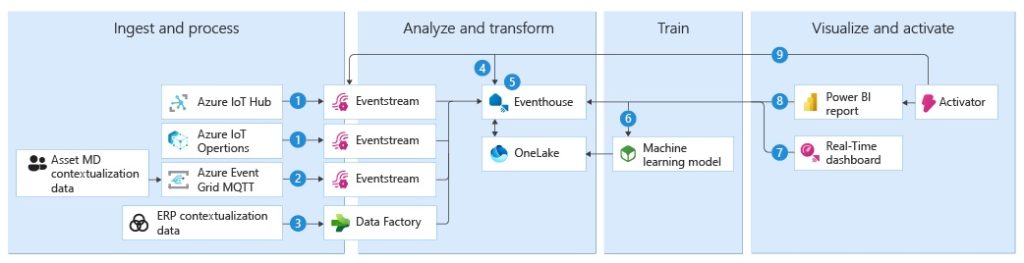
Eventstreams ingest high-velocity tag data and IIoT telemetry. Eventhouse stores it in a time-series-optimized format. Real-Time Dashboard surfaces it with sub-second latency. Microsoft’s Connected Factory reference architecture documents Fabric streaming over one million IIoT events per hour from 30,000 tags across 40 factories. The gap between an alarm on the line and a response from operations is where downtime accrues.
Manufacturing data solutions and ISA-95 enrichment
Fabric includes manufacturing-specific data solutions that ingest MES, historian, and IIoT data and enrich it against ISA-95, the industry standard for control-system to enterprise-system integration. The enrichment turns raw tag data into something a corporate analyst can query. Without the ISA-95 context, a tag called “TT_124_PV” is meaningless above the plant floor; with it, the same tag becomes a temperature reading on a specific asset in a specific cell.
Power BI and Copilot for the top floor
Power BI sits natively on top of OneLake, so plant-level real-time dashboards and corporate KPI views work from the same data, not from extracted copies. Copilot in Fabric lets operations and finance teams query manufacturing data in plain language. The question that previously triggered a three-day IT ticket gets an answer in a chat window.
How Fabric connects the shop floor to the top floor in practice
Connecting the shop floor to the top floor is not a single project; it is a set of recurring decisions made faster because the data lives in one place. Three workflows show what unified data actually enables.
Real-time OEE across plants
Overall Equipment Effectiveness is the single most-watched manufacturing KPI and the one most frequently calculated wrong because each plant defines availability and quality slightly differently. Unifying tag-level data in Fabric and applying a single OEE definition across all plants gives the executive team a comparable cross-plant view and gives the plant team the same view at minute-by-minute granularity.
Root cause analysis without four spreadsheets
When yield drops on a line, the root cause typically involves process parameters, material lot, ambient conditions, and a maintenance event from three shifts earlier. Pulling those four data sources into one query is the difference between finding the cause in an hour and finding it in a week.
Predictive maintenance grounded in real history
Predictive maintenance models live or die on access to clean historical tag data tied to failure events. Fabric Data Science trains models on historical data sitting in OneLake without exporting it to a separate ML platform, and the prediction outputs land back in the same Power BI report that the maintenance manager already uses.
How Advaiya implements Microsoft Fabric for manufacturers
Advaiya is a Microsoft Solutions Partner across five designations, including Data and AI, with multi-plant implementation experience across discrete and process manufacturing. Our work focuses on the architecture decisions that determine whether Fabric becomes a working operating layer or another partially-loaded data lake.
Our smart factory transformation practice connects MES, historian, ERP, and quality systems to Fabric with the data model, naming standards, and ISA-95 enrichment that make cross-plant analytics realistic. The same discipline carries across our real-time IoT work in cement plant operations, our data unification on the automotive manufacturing floor, and our BI reports and dashboards practice that builds the Power BI layer for operators, plant managers, and the C-suite. Our Fabric-based ESG reporting work for energy and infrastructure shows the same architecture extending to sustainability data.
Stop running the plant on yesterday’s data
If your operations team is making decisions on Monday using OEE numbers from the Friday before, the cost is not a reporting gap; it is every shift of yield, energy, and maintenance opportunity that passed while the data was being assembled. Talk to our team about a Fabric architecture that gives the shop floor and the top floor the same view of the plant at the same time.