Manufacturing leaders are caught between two pressures, which the consulting industry usually treats as a single choice. Production teams want AI-driven analytics, predictive maintenance, smarter scheduling, and automated workflows. The board does not want to fund another multi-year ERP replacement program with a real chance of missing its business case. Treated as one decision, the two pressures cancel each other out. Treated as separate layers of the enterprise architecture, they resolve into a clear path.
That path is Peripheral Automation. The principle is straightforward: extend stable core systems with adaptive data, process, and AI-led capabilities at the periphery, rather than ripping out the core to install a newer version of the same core.
Why manufacturing ERP replacement projects keep failing
ERP replacement projects fail at a rate the manufacturing industry has learned to tolerate. Gartner predicts that more than 70% of recently implemented ERP initiatives will fail to fully meet their original business case goals by 2027, with as many as 25% failing catastrophically. The cost is not just license fees and the system integrator bill. The real cost is the two to three years the operations team spends in implementation meetings instead of running the business.
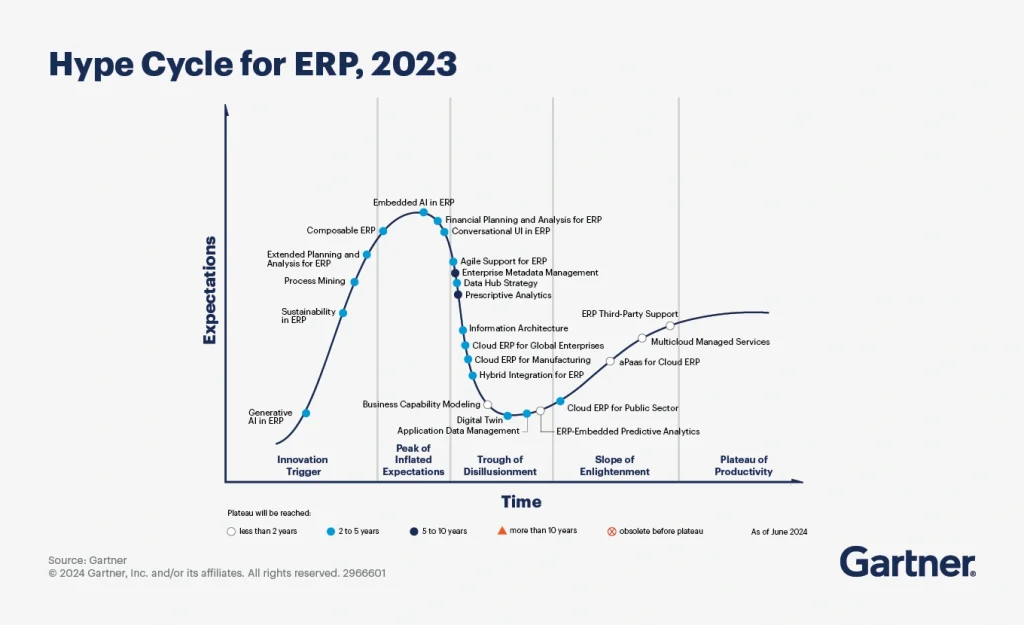
The pattern repeats because the core ERP carries decades of process logic, master data, and operational habits that are extraordinarily hard to move. Customizations made fifteen years ago by people who have since left the company are still doing useful work. Tear that out, and the replacement project ends up rebuilding the same logic in a new system, slower and at greater cost than planned.
The smarter question is not “which ERP should we replace this one with?” but what work the core ERP needs to keep doing well, and what work should sit outside it.
What is peripheral automation in manufacturing
Peripheral Automation is an enterprise architecture approach that separates the manufacturing technology estate into three layers and confines change to the outer two. The core stays stable. The periphery moves fast.
The core: data integrity and transactional record
The core is the ERP, the financial general ledger, the MES system of record, and the master data that runs them. The core’s job is to be reliable, auditable, and slow to change. Replacing it is expensive and risky, and most of the time, it is not what the business actually needs. Peripheral Automation keeps the core in place and protects it.
The process layer: workflows, automation, and AI agents
The process layer is where most manufacturing transformation value lives. Workflow automation in Power Platform, AI agents for triage and decision support, RPA bots for invoice processing, and no-code apps for shop floor data capture all sit on top of the core. The process layer reads from and writes to the core, but is not the core, and the whole layer can be replaced, extended, or retired without touching the ERP.
The experience layer: dashboards, interfaces, and conversational AI
The experience layer is what plant operators, engineers, finance teams, and executives actually see. Power BI dashboards, Copilot-style assistants, embedded analytics inside Dynamics 365, and mobile field apps all live here. Changing the experience layer does not require a project plan; it requires a sprint.
The architectural discipline is that change at the experience and process layers does not propagate into the core. Conversely, the core can eventually be modernized when business needs justify it, without forcing the periphery to be rebuilt at the same time.
How peripheral automation adds AI to manufacturing without replacing the core ERP
Peripheral Automation in practice means a portfolio of small, additive moves that compound. Four patterns appear across most manufacturing engagements.
AI agents on top of the ERP, not inside it
An AI agent that reads supplier invoices, validates them against the purchase order, flags anomalies, and posts the clean ones into the ERP delivers most of the value of an “AI-native ERP” without the cost of replacing the ERP. The agent reads ERP data through standard interfaces; the ERP stays untouched.
Real-time analytics layered onto historian and MES data
Power BI on a Microsoft Fabric data layer reads from the historian, MES, and ERP and presents real-time OEE, yield, and quality views without changing any source system. The plant analytics team builds new reports in weeks.
Process automation in the gaps the ERP does not cover
Most manufacturers have a dozen processes the ERP could handle in theory but does not handle well in practice: rework approvals, deviation tracking, supplier quality returns, SOP acknowledgments. Power Platform apps and Power Automate flows handle these natively, with a cleaner user experience, and write the necessary records back to the ERP.
Predictive models that recommend, not control
Predictive maintenance and demand forecasting models trained on production data produce recommendations that surface in the existing scheduling and planning tools. The ERP’s planning engine still runs the plan; AI improves the inputs. Risk stays contained because the model never directly controls the line.
How to plan a peripheral automation roadmap for manufacturing
A Peripheral Automation roadmap is sequenced by business impact, not by technology. Four principles separate the deployments that compound from the ones that stall.
Start with one high-volume, low-risk process
The first deployment should be a process that runs many times a day, has a clear measurable cost, and does not affect financial close. Invoice processing, purchase requisition routing, and quality non-conformance workflows are typical first wins.
Treat the integration with the ERP as the architecture decision
The hardest part of Peripheral Automation is not the AI model or the no-code app; it is the read-and-write interface to the core ERP. Investing in a clean integration pattern, ideally on Power Platform or Microsoft Fabric, pays back across every subsequent project.
Sequence by data dependency, not by technology
AI and automation depend on clean, contextualized data. Building the data layer first, even minimally, is what makes the rest of the roadmap deliver. A plant with unified, ISA-95-enriched production data deploys a new use case in weeks; a plant without it lands in a data-cleaning project every time.
Make adoption the success metric, not deployment
Peripheral Automation is judged by how many people are actually using the new workflow six months in. A deployed solution that no one uses is the most expensive form of failure. Adoption planning, training, and change management belong in the roadmap from the start.
How advaiya delivers peripheral automation for manufacturers
Advaiya developed Peripheral Automation as its core methodology and applies it across manufacturing, energy, and project services engagements on the Microsoft stack. The approach is grounded in our thought leadership on balancing continuity and change in AI integration and runs through our AI strategy consulting, business process automation, and embedded analytics practices.
For manufacturers, that translates into AI agents on top of Dynamics 365 and SAP, Power Platform apps closing the gaps the ERP does not cover, real-time analytics on Microsoft Fabric reading from historian and MES, and predictive maintenance models that surface recommendations in the tools operators already use. The ERP stays in place; the value gets delivered around it.
Stop choosing between AI ambition and ERP stability
The instinct that adding AI requires replacing the core system is the most expensive misconception in manufacturing IT. Talk to our team about a Peripheral Automation roadmap that delivers AI and automation in months, without putting the ERP at risk.