Marketing operations is the discipline of connecting strategy to execution through standardized processes, integrated technology, and reliable data. It’s what turns a marketing department from a collection of individual contributors running campaigns in email threads into a scalable engine where briefs flow through approvals, creative assets route to the right channels, and performance data feeds back into the next planning cycle automatically.
For CTOs and COOs overseeing marketing technology decisions, this isn’t about buying another tool. It’s about building the operational infrastructure that lets a 20-person team produce the output of a team three times its size, without burning out or losing quality control.
The gap between marketing ambition and marketing execution is almost always a workflow problem.
The workflow problem: why marketing teams can’t scale
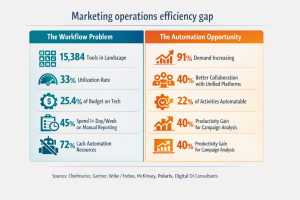
The marketing technology landscape now includes 15,384 tools in 2025, growing 9% year over year (Digital DI Consultants / Chiefmartec, 2026). Yet marketers use only 33% of their MarTech stack capabilities, down from 58% in 2020 (Digital DI Consultants / Gartner, 2026). Organizations spend 25.4% of their marketing budget on technology that is largely underutilized.
The problem isn’t a lack of tools. It’s a lack of connected workflows between them.
Where marketing teams lose time
Large marketing teams of 50 to 100+ people struggle with fragmented workflows and duplicated effort (Digital DI Consultants, 2026). 45% of project managers spend more than one day per week manually compiling status updates (Wrike / Forbes, 2026). 72% of companies cite the lack of marketing automation resources as a significant challenge for content marketing (Email Vendor Selection, 2025).
McKinsey’s 2025 analysis found that up to 22% of a brand marketer’s current activities can be automated within five years, with productivity gains of roughly 40% for campaign monitoring and performance analysis (McKinsey / monday.com, 2025). That potential stays unrealized when campaign briefs live in email, approvals happen in chat messages, and performance reporting requires manual spreadsheet consolidation.
The market is investing heavily in automation
The marketing automation market was valued at $7.3 billion in 2023 and is expected to grow at a 12.74% CAGR through 2032 (Email Vendor Selection / Polaris, 2025). 91% of organizations say demand for automation is increasing, with requests coming from marketing (26%), R&D (39%), operations (38%), and customer service (33%) (Email Vendor Selection, 2025).
64% of marketers already use automation and AI, while 62% find it important to their marketing (Email Vendor Selection, 2025). Enterprise teams using unified campaign platforms report 40% better collaboration and nearly doubled delivery speed (Digital DI Consultants, 2026).
Where the industry is heading
From static workflows to self-optimizing systems
Marketing automation is shifting from scheduled, rule-based workflows to AI-driven systems that adapt in real time. AI-powered predictive engagement determines the best time, channel, and message for each audience segment. 62% of organizations are already experimenting with AI agents for marketing operations (Digital DI Consultants, 2026).
AI-powered marketing work is expected to grow from 17.2% to 44.2% of total marketing output (Digital DI Consultants / Gartner, 2026). The shift isn’t replacing marketers. It’s removing the operational overhead that keeps them from doing strategic work.
Unified platforms replacing point solution sprawl
The biggest threat to MarTech ROI is hidden costs from brittle integrations and undocumented APIs that erode returns over time (Digital DI Consultants, 2026). 28% of B2C marketers say their technology stacks are too complex (Digital DI Consultants, 2026). 64% of organizations acknowledge a lack of internal marketing technology expertise (Digital DI Consultants, 2026).
The industry response is consolidation around unified work management platforms that connect campaign planning, creative production, approval workflows, channel execution, and performance reporting in one system.
Personalization driving workflow complexity
71% of consumers expect personalized interactions, and 76% will switch brands if they don’t get them (McKinsey / Digital DI Consultants, 2026). Companies excelling at personalization drive 40% more revenue from those activities (McKinsey, 2025). That level of personalization requires campaign workflows that can handle hundreds of variations without manual intervention at each step.
How monday.com and Power Platform build the workflow engine
Monday.com: the campaign operations backbone
Monday.com is the only work management platform recognized as a Leader across three 2025 Gartner Magic Quadrant reports: Marketing Work Management Platforms, Collaborative Work Management, and Adaptive Project Management and Reporting (Gartner, 2025). In the CWM report, monday.com was positioned furthest for both Completeness of Vision and Ability to Execute among all vendors evaluated.
For marketing operations, monday.com provides the campaign workflow infrastructure that replaces email-and-spreadsheet coordination:
- Campaign intake and brief management that routes requests through standardized templates with required fields, eliminating incomplete briefs that cause rework
- Approval workflows with automated routing based on campaign type, budget threshold, and stakeholder requirements
- Workload management that shows capacity across creative, content, media, and analytics teams before assigning work
- Cross-functional visibility where creative, media buying, analytics, and leadership all see campaign status without requesting updates
Microsoft Power Platform: process automation and integration
Power Platform (Power Automate, Power Apps, Power BI) extends monday.com’s campaign workflows into the broader enterprise technology stack. Power Automate connects campaign approvals to financial systems, triggers asset distribution when campaigns go live, and routes performance data back to monday.com dashboards without manual data entry.
Power BI embeds campaign performance dashboards directly inside the monday.com workspace, so marketing leadership sees budget consumption, channel performance, and conversion metrics where they plan work, not in a separate analytics tool they check once a week.
For organizations running Dynamics 365 for CRM or Business Central for finance, Power Platform creates the bridge between marketing operations and the rest of the business without custom development.
How Advaiya helps marketing teams implement workflow automation
Advaiya works with organizations across enterprise marketing, professional services, and technology on business process automation and monday.com implementations within the Microsoft ecosystem.
When Advaiya deployed 60+ Power Platform applications for a large enterprise group, the results demonstrated what structured workflow automation delivers at scale: billing time reduced from 30 hours to 4, 7x faster processing, 100% visibility on work orders, and 5 minutes to complete tasks that previously required manual coordination across multiple teams (Advaiya Case Study Compendium).
Advaiya brings the operational architecture expertise that connects monday.com’s campaign management capabilities with Power Platform’s automation and integration layer, so marketing teams get a workflow engine built for how campaigns actually move from brief to performance review.
Connect with Advaiya about marketing workflow automation →