Multi-client campaign management inside an advertising agency is fundamentally different from project management in most other industries. Each client account operates like its own business unit with a distinct brand identity, media strategy, creative approval chain, flight schedule, and performance target.
A single agency managing 50 accounts might have 200 active workstreams on any given Monday: creative briefs moving through review, media buys being negotiated against flight dates, analytics teams pulling CTR and ROAS reports for weekly client calls, and account directors reconciling it all against retainer scopes and budget pacing.
The coordination challenge isn’t that any single campaign is complicated. It’s that 50 of them are running simultaneously, each at a different lifecycle stage, each requiring handoffs between creative, media, strategy, and analytics teams that often don’t share the same tools, timelines, or even vocabulary. When information lives in six different systems: a brief in email, a media plan in a spreadsheet, creative assets in a cloud folder, reporting in an analytics dashboard, time tracking in a standalone app, and client communication in a chat thread, the agency doesn’t have an information problem. It has a visibility problem.
The operational reality: why agencies are losing time and margin
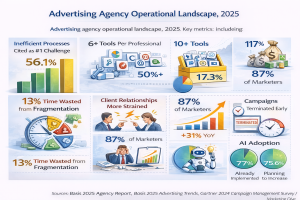
The numbers behind agency operations paint a clear picture. The 2025 Basis Advertising Agency Report, based on a survey of hundreds of agency professionals, found that 56.1% cite inefficient processes as the top challenge currently facing their organization. More than 60% believe digital advertising has gotten harder over the past two years, and 76.6% say their individual jobs have grown more challenging (Basis, 2025 Advertising Agency Report).
The root cause isn’t workload alone; it’s fragmentation. Basis’s trend analysis[1] found that more than half of agency professionals juggle six or more tools to manage client campaigns, and 17.3% use ten or more. Research shows teams waste 13% of their time and 12% of their effort when different platforms don’t work well together (Basis, 2025 Advertising Trends). That’s roughly a half-day per week per person lost to switching between systems, re-entering data, and hunting for information that should be immediately available.
On the client side, Gartner’s 2024 Channel Campaign Management Survey found that 87% of marketers experienced issues with campaign performance in the past 12 months, with 45% reporting they potentially needed to terminate a campaign early due to poor performance. Campaign volumes increased 31% year-over-year, while only 45% of marketing budgets actually go toward campaigns; the remaining 55% goes to technology and transformation (Gartner / Marketing Dive, 2025). The implication for agencies: clients are demanding more campaigns, scrutinizing performance more closely, and operating with less budget cushion than ever.
Meanwhile, client relationships are fraying. In 2024, 43.4% of agency professionals said their client relationships were more strained than two years prior (Basis, 2024). And 77% of agencies have already implemented AI-driven processes in daily operations, with 75.6% of leaders planning to increase AI tool investment in the next 12 months (Basis 2025, AgencyAnalytics 2024), signaling that the agencies not investing in operational efficiency are falling behind those that are.
Where the industry is heading: AI, automation, and tech stack consolidation
Three shifts are reshaping how agencies need to think about their operational infrastructure.
The first is tech stack consolidation. Agencies that grew by bolting on a new tool for every function, one for project management, one for time tracking, one for proofing, one for reporting, are now paying the coordination tax. The move is toward unified platforms that connect creative production, resource planning, client communication, and performance reporting in a single environment, eliminating the data silos that fragment visibility and slow handoffs between teams.
The second is AI moving from content generation to operational intelligence. The most impactful AI applications for agencies aren’t writing ad copy; they’re categorizing incoming creative requests, summarizing long client feedback threads, detecting sentiment in campaign responses, and flagging at-risk campaigns before they miss deadlines. This is the shift from AI as a creative tool to AI as an operational layer that reduces the cognitive overhead of managing dozens of accounts simultaneously.
The third is the evolution from project management to work management. Traditional project tools track tasks and deadlines. What agencies need is portfolio-level visibility: the ability to see every client account, every campaign stage, every resource constraint, and every performance metric in one view so leadership can make allocation decisions based on real capacity rather than gut feel.
How monday.com fits the way ad agencies actually work
Monday.com is the only work management platform recognized as a Leader across three 2025 Gartner Magic Quadrant reports: Collaborative Work Management, Adaptive Project Management and Reporting, and Marketing Work Management Platforms (Gartner, 2025). In the CWM report, monday.com was positioned furthest for Completeness of Vision and highest for Ability to Execute among all vendors evaluated, a first for the platform on both axes simultaneously. Total Economic Impact[2] study reports 346% ROI for Motorola, with a payback period under four months (Forrester TEI, 2025).
For advertising agencies, monday.com’s Work OS maps directly to the way multi-client campaigns flow. Creative brief intake uses Forms to standardize how requests enter the system, capturing client, campaign type, deliverables, flight dates, and media channel in a structured format rather than buried in email threads. Automated workflows then route briefs through approval stages, notify the next person in the chain, and prevent production from starting on work that hasn’t been signed off.
Portfolio-level dashboards give agency leadership a single view across all client accounts. Campaign status, budget pacing, team utilization, and milestone health are visible without opening 50 separate project boards. The Workload View shows real-time capacity across creative directors, copywriters, media buyers, and strategists, so when a new media buy lands or a client escalates a campaign, leaders can see who has bandwidth before making assignments.
AI Blocks built into the platform handle the operational intelligence layer that agencies increasingly need. Categorize automatically tags incoming requests automatically as “paid social,” “creative refresh,” “urgent” based on text analysis. Summarize condenses long client update threads into key takeaways. Detect sentiment gauges whether client feedback is positive, neutral, or negative, helping account teams prioritize responses. Extract info pulls flight dates, budgets, and deliverables directly from uploaded briefs and media plans into board columns.
Monday.com integrates with 200+ tools, including Slack, Microsoft Teams, Google Drive, Gmail, Outlook, Zoom, Jira, and Harvest, connecting the platforms agencies already use rather than replacing them. For agencies tracking media performance, data from Google Analytics, advertising platforms, and reporting tools can flow into monday.com dashboards, giving account teams and clients a consolidated view of CTR, ROAS, and spend pacing alongside project status.
Pricing scales from a free tier (two seats, three boards) through Basic ($9/seat/month), Standard ($12/seat/month with 250 automation actions), Pro ($19/seat/month with 25,000 automations), and Enterprise with custom pricing. Annual billing provides roughly 18% savings.
How Advaiya helps agencies implement monday.com for scalable campaign operations
Advaiya works with organizations across advertising, media, and professional services on project and portfolio management implementations. When Advaiya deployed a digital transformation for a large landscaping group managing multi-location operations, the parallels to agency operations were direct: 60+ custom applications built on Power Platform for workflow automation and reporting, billing time reduced from 30 hours to 4 (7x faster), and 100% visibility on work orders across distributed teams. For agencies, that same methodology, decomposing complex multi-stakeholder workflows into automated, trackable processes, translates to creative production pipelines, media buy coordination, and client reporting that runs without manual overhead.
Advaiya brings enterprise architecture expertise and implementation methodology that connects how your account, creative, media, and analytics teams actually work to how monday.com gets configured so the platform reflects your agency’s real workflow rather than a generic project template.
Connect with Advaiya about monday.com for your agency →