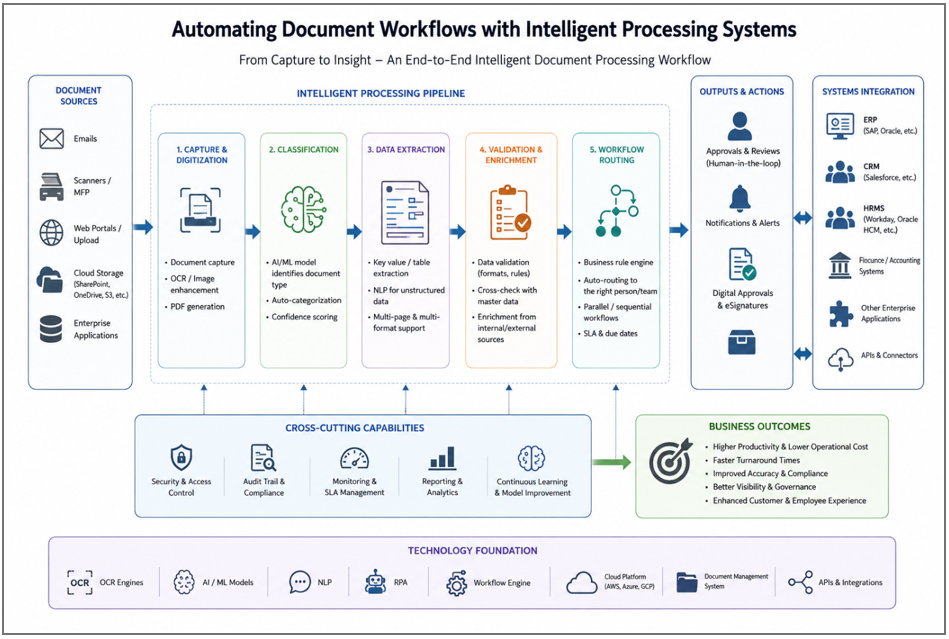
“Automating document workflows with intelligent processing systems” involves leveraging AI-enabled technologies to capture, process, analyze, and route documents with minimal human effort. These systems integrate automation, machine learning, OCR, natural language processing, and workflow orchestration to enhance processing speed, data accuracy, compliance, and overall operational efficiency across enterprise business functions.
Organizations today deal with large volumes of invoices, contracts, forms, reports, emails, purchase orders, HR records, and customer documents. Traditional document handling methods are time-consuming, error-prone, and heavily dependent on manual data entry. Intelligent document processing systems transform this by automatically extracting, validating, classifying, and processing information in real time.
- Key capabilities of intelligent document workflow systems include:
- Intelligent document ingestion from emails, scanners, web portals, and cloud-based repositories
- OCR-enabled extraction of data from PDFs, scanned files, images, and digital documents
- AI-powered document identification and automated categorization
- Automated data verification, validation checks, and exception management
- Rule-based workflow orchestration and task routing across business processes
- Seamless integration with ERP, CRM, HRMS, and other enterprise platforms
- Digital approvals, alerts, notifications, and audit trail management
- Real-time analytics, dashboards, and reporting for enhanced operational visibility
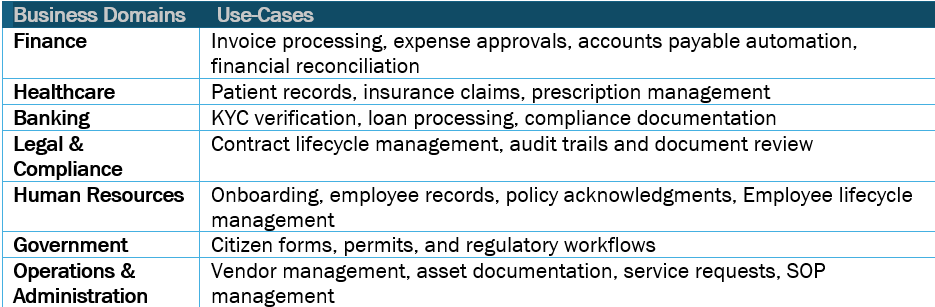
These solutions are widely used across industries:
Modern intelligent processing platforms leverage AI models to continuously improve recognition accuracy and decision-making. For example, the system can learn different invoice formats from vendors, identify missing fields, flag anomalies, and route exceptions to the appropriate teams automatically.
Major business benefits include:
- Reduced manual effort and operational cost
- Faster turnaround time and approvals
- Improved data accuracy and compliance
- Better document traceability and governance
- Enhanced customer and employee experience
- Scalable processing for growing business volumes
In the AI era, intelligent document workflows are evolving beyond simple automation into cognitive systems capable of understanding context, summarizing content, detecting risks, generating insights, and supporting business decision-making. As organizations continue their digital transformation journey, intelligent document processing is becoming a foundational capability for building efficient, scalable, and data-driven operations.
Advaiya’s peripheral automation approach extends intelligent document processing by connecting business workflows, enterprise applications, and operational touchpoints into a unified automation ecosystem. Instead of automating only the core document flow, peripheral automation focuses on surrounding business activities such as notifications, approvals, validations, integrations, reporting, audit tracking, and user interactions. By leveraging AI, workflow orchestration, Microsoft ecosystem technologies, and enterprise integrations, Advaiya helps organizations reduce manual dependencies across departments while improving process visibility, compliance, and operational agility. This enables businesses to create scalable digital operations where documents, data, users, and systems work together seamlessly to support faster decision-making and improved business outcomes.